|
|
List including satellites in inclined orbit Dish interference: Site shielding |

Inclined orbit operation of geostationary satellites
Explanation of how geostationary satellites eventually run short of fuel and start to move north-south and how tracking antenna may be used to extend operational life.
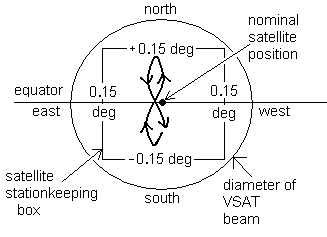
Once placed accurately into its geostationary orbit position the inclination gradually increases, so it starts to drift north-south on a daily basis due to the influence of the sun and moon. There is a gradual increase in the inclination of the orbit. If left alone, a satellite that has initial zero inclination will have its inclination increase at the rate of 0.8 deg per year.
It is usual not to let the maximum north-south movements exceed +/- 0.15 degree to allow the use of large numbers of fixed pointing moderate sized and VSAT antennas. It is accepted that the largest teleport stations need to have tracking capability. If nothing were done, the 0.15 deg limit would be exceeded after about a month and moderately sized, but fixed, dishes would start to see signal increases and decreases during each day. If left much longer, even VSATs would need tracking motors.
To solve this problem, satellites start their life in the geostationary orbit with a substantial amount of rocket fuel which is used periodically every few weeks to correct the trend toward orbit inclination increase. Typically a brief burst firing of the north-south thrusters will be made as the satellite crosses up across the equator so that instead of continuing gradually upwards it instead goes gradually downwards, effectively into negative inclination. The inclination then reduces over the next few weeks to zero and then increases again, by which time another thruster firing is needed.
The net result is that over a period of 10 to 15 years the station-keeping fuel is gradually used up, but for the whole of this period the satellite is maintained within +/- 0.15 deg north-south of the equator.
A small proportion of the total fuel is used for east-west orbit adjustments, since there is a tendency for it to very slowly drift sideways due to the triaxial nature of the earth. Gravity is slightly stronger at three points around the equator.
Once it is getting near the end if its normal north-south station-keeping the operators decide to stop and concentrate the remaining fuel on the much more economic east-west station-keeping so as to extend the life by several more years. During this periods it is kept in its east-west position so that interference to adjacent satellites is avoided, but its inclination is allowed to increase to say +/- 5 deg over 6 years. The communications payload continues to operate, with some loss of performance at the edges of the coverage beams since they no longer always point accurately at the countries on the ground all of the time.
Modern satellites may use 'electric' ion thruster propulsion which involves a stored gas 'fuel' such as xenon, which is very slowly released and ionised using an electricity supply and then accelerating to the ions to extremely high speed with a high voltage anode and discharging the stream of ions very fast, this generating a very small thrust. Applied over a very long period of time this can help put the spacecraft to geo height but is predominately used for station-keeping, potentially 15 - 20 years, depending on the tank size. Refuelling in orbit has not yet been done but satellite extended life has been done using a docked smaller spacecraft equipped with just fuel and thrusters.
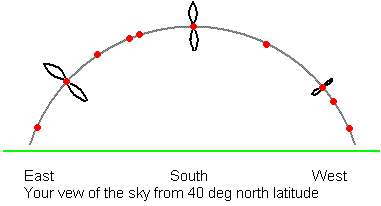
View of the geo orbit, with movement of three slightly inclined satellites shown.
The figure above shows nominal (red) orbit positions along the geostationary orbit. The 'top' satellite is on the same longitude as you, so the equator appears horizontal. If you are not aiming not the 'top' one, the orbit line is tilted relative to your local horizon. Either side and to the north and south are the 0.15 deg station keeping box limits. The example satellite path below shows a figure of eight or ellipse movement over one day. The diameter of the beam from a 1.2m 14 GHz VSAT earth station dish is shown surrounding the area. Calculator for VSAT satellite dish gain and beam width. The satellite remains within the beam. A large teleport earth station may have a beam 10 times smaller diameter and would need tracking, even to follow the approx +/- 0.1 deg diurnal movement shown.
The figure above shows three satellites in inclined orbit. One has only a small inclination, the other two much larger. The scale here is exaggerated for clarity.
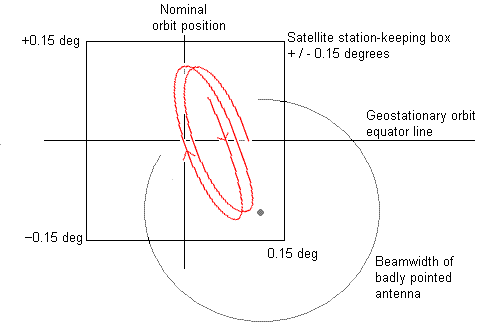
Above is the result of having a badly pointed VSAT antenna, which sees a big signal drop
for a few hours each day when the satellite has moved to the north easterly position. This satellite is very slowly drifting to the west.
During the inclined orbit years, earth stations must must have tracking systems so that their pointing is adjusted to aim at the satellite all during the day. The beam pointing movement is classically a lissajous "figure of 8", but might at times be a tall slim elliptical shape or tilted elliptical shape.
Suggested link for single axis tracking system:
Single-axis: RCI RC1500 single axis inclined orbit satellite tracking controller from Research Concepts
Implications for earth station inclination tracking
To avoid loss of service, the earth stations need to track the satellite following the daily sinusoidal movements. If you are located on the same longitude as the satellite the north-south daily movement will be up and down. If you are on the equator then all the satellites are in a straight line across the sky from east to west, via directly overhead. North-south movement of all these satellites will be a sideways movement. Anywhere else and you have daily diagonal movements to contend with, which means using two motors for an azimuth-elevation mount or a declination only motor on a polar mount dish.
Due to the problems with tracking and the uncertainty of operation of old satellites in GEO Orbit, that have exceeded their regular life, the prices charged for satellite transponder capacity are lower. It is often possible to make use of this capacity my implementing polar mounts with simplified north-south inclination tracking only. This means using a dish size which will cope with +/-0.15 deg east west movements.
The tracking of satellites in medium and lower earth orbits, called MEO and LEO, requires both azimuth and elevation tracking of the dish.
Follow this link to forum posting providing an
explanation of antenna tracking systems.
|
Page last amended 15 Aug 2017, 17 Nov 2024, 22 July 2026. |