|
|

| SatSig Topics Index › Satellite Internet - Americas › How to get online in Cuba |
SatSig topic: How to get online in Cuba(Read 16862 times) |
|
Jun 2nd, 2006 at 3:26pm
Would like to know who can provide me with up to date info about dishsizes, modems and ISP which and who will cover Cuba. Are there no Canadean/Mexican/Venezuelan or other nonUSA satellites and or ISP around who cover Cuba. These because of the embargo. Equipment could be send to a third country. I do have some computer knowledge. Mac and Windows. Any advise is welcome and thanks in advance. Rickenbilly |
|
Jun 3rd, 2006 at 2:55am
Nobody knows? Is this an UK or an USA forum. I am confused with the time on this site. Hope you guys and/or girls can help me out. regards, Rickenbilly |
|
Jun 3rd, 2006 at 2:56pm
The difficulty is just political. Check out the current US export regulations if they change in your favour then it should not be too long before you can get service. This forum works worldwide, I hope. The server clock is approx 70 minutes ahead of Greenwich Mean Time see https://www.satsig.net/maps/lat-long-finder.htm Best regards, Eric. |
|
Jul 24th, 2006 at 6:05am
THAN still you have the providor issue, CANT BE USA So, it has to be Hispasat - expensive and mostly unstable (i really don't know what type of technicians they have there) THAN You will have to deal with the political situation in Cuba, and they don't like any uncontrolled communication. The only ones we could get around this are registered diplomats and embassies, but still they have to do a bunch of paperwork. |
|
Oct 18th, 2006 at 3:01am
How they physically get there I don't know and even if someone knew they would be crazy to admit it here on a public forum. If you can get drugs into a country you can certainly get a VSAT in there. I hear a .98 dish with a nova modem on AMC-6 has been proven on the southern end and a standard .75 Nova on AMC-6 is marginal but mostly operational on the northern end. |
|
Oct 20th, 2006 at 7:50am
If the service provider is from another country, nobody really knows what (big brother) USA will do. Signals enough Equipment getting in - no problem connecting ...... (and staying alive and out of jail as client) ???? |
|
Oct 24th, 2006 at 7:22am
|
|
Oct 31st, 2006 at 3:32pm
There are surely ways to fake this out, but most outside the business wouldn't know about it unless the network operator assisted, thus making them liable if caught. I concur with the desire to help bring communication to the "resisters," but it would be better to get a government sponsored program to do this, than do it as a law-breaking individual or company! |
|
Oct 31st, 2006 at 4:21pm
Now you may say that the ISP would know the delay and therefore be able to deduce where the modem is from that, but in reality all they would be able to deduce is that it is somewhere in an arc about 100 miles wide and many thousands of miles long stretching across the united states and into Cuba. Any equidistant point to the satellite will have the same delay. Imagine stretching a long string from the satellite to Cuba and scribing a line in an arc across the USA and you get the picture. Viva la resistance !!! |
|
Oct 31st, 2006 at 6:06pm
both HughesNet and Starband modems are now auto ranging Unless you can produce supporting documentation from each manufacturer for each modem currently fielded, I'm afraid I'm going to have to challenge that statement. //greg// |
|
Oct 31st, 2006 at 6:49pm
Same with HN. look at all the mobile Rv customers they have, a simple google of Hughesnet or starband tripod satellite INTERNET will return a lot of dealers. there are even yahoo groups devoted to the subject. In the early days when *B was first out it would not work unless the delay was set properly and then you had to do a zip code trick along the arc to get them to work OCONUS but this is no longer necessary. commission a modem in Raleigh NC and no matter where you take it it will boot up, auto range and work just fine. Look at my website, I would not be selling so many portable systems and have a 5 star platinum rating for superior customer support and high volume sales unless it worked and had the tacit approval from Starband to do so. If you want testimonials I would be happy to provide customer e-mails and you can ask them yourself. I swear I am not pulling your leg. BTW the modems in question are: Starband: 360, 481, 484, and the new Nova series HN: 6000, 7000, 7000s All auto ranging without any intervention required from the NOC |
|
Nov 1st, 2006 at 12:01am
Starband: 360, 481, 484, and the new Nova series HN: 6000, 7000, 7000s Thank you, that list proved my point. It only identifies modems that are "self-hosted". You've neglected to consider the thousands of PC-based modems still in commission. Not to mention that they're still being sold daily on eBay. As you've already intimated, PC-based modems must be told exactly where they're located before they can even sync up with the network timing loop. PS: I don't think the 360 belongs on your list. Or did you forget about the "Mission Control" software? //greg// |
|
Nov 1st, 2006 at 12:26am
Please post back here what you find out so we have a record for future inquiries on this forum. regards, Max |
|
Nov 1st, 2006 at 1:48am
I have an commissioned DW4000 online right now, I know it auto-ranges in conjuction with each ACP validation or revalidation - whether user initiated or automatic. I admit never having any hands-on experience with the SB360. But I have found the page (23) in the Starband 360 operator's manual (STR-IM22-7.02) that illustrates where modem location is typed in by the user; Mission Control/Customer Input Wizard/Configure Satellite Delay. Enter ZIP or Lat/Lon. //greg// |
|
Nov 1st, 2006 at 4:00am
Now for Starband I do know quite a bit and labor under no impression just solid fact, over 300 customers and hundreds more installs. In the early days of the 180 and 360 equipment it did not matter if you put in a different zip code or long/lat in the modem configuration tool, if the NOC had you set at a certain location nothing you did on your end was going to change it unless you found a zip code in the USA that was equidistant to the satellite from your OCONUS location (hence the same delay value). Then you had to do an address change with the NOC to get it to work. Needless to say this was a PITA. About a year after the introduction of the 360 Starband began upgrading all it's hubs with HBR technology (hub burst receiver technology) (except cluster 50 more on that later) and sending downloads to customers with new firmware. From that point on all 360's and future series modems did not care where they were located. On boot up the TX would flash a few times and the modem calculated it's delay and would come online. There here is absolutely no cross-pol (ACP) or co-pol validation that takes place with Gilat modems. If you are looking at the correct bird and have your polarization angle even close to correct you are online. It is up to the individual user to call the automated system (CVACS) and make sure you are meeting alignment criteria. If not you better correct it because they monitor all VSATs and in the next 24 to 48 hours you will get flagged. If you are not too far off they send you and the dealer of record a polite e-mail to correct it or you get shut off by a certain deadline. If you are really incompetent and are way off they turn you off immediately and wait for you to call in wondering what happened. If you repeatedly get flagged and are a bad boy they put you on cluster 50 which is not auto ranging and requires you to be in a fixed location. violate the antenna alignment often enough on 50 and they shut down your site permanently and revoke your certification. This is a very big difference between HN and Gilat. With HN if you don't pass you don't get online. With Gilat you get online even if you are off on cross but risk being shut down if not corrected. I can emphatically and without reservation state that all 360 modems are completely auto ranging and require absolutely no reconfiguring with a new zip code or long/lat if moved. I know, I still have around 100 customers doing it right now. The original point I was trying to make, and I believe I did, is that there is no way for an ISP like HN or *B to know where your modem is and that they in no way have to be part of a process that enables you to move your modem to a location other than where it was originally commissioned. In other words, they don't have to help you and they can't be held liable if you want a working system in Cuba. It's up to you and your responsibility alone if you want to take that risk. BTW I notice at the link you posted that they reference starbandusers.com. Great site, I have been a member since 9/30/2001 with 2,856 posts as of today so it think it might be fair to say that with all due respect, when it comes to starband and gilat equipment I do know what I am talking about |
|
Nov 1st, 2006 at 5:02am
I am not sure exactly how the tool works, what it changes or exactly when you need to use it Simple. It changes latitude/longitude in the System Control Center (user interface). Users can perform the function manually by pointing any browser to 192.168.0.1 These pages are internal to the modem, and are several levels deep. Here the modems' software is manipulated to change geoloco. Force ranging is performed in this manner also. Don's utility just saves all the keystrokes. See https://www.datastormusers.com/dssattool.cfm But since SB seems to be your forte, I'll not challenge the method (or lack of ) that they regulate transmitter isolation. My point however, was that you made a huge sweeping generalization, suggesting that auto-ranging is some kind of magic bullet that precludes having to actually tell modems where there located. Your point on the other hand - that a satellite provider is unable to pinpoint the location of a specific modem - is apparent speculation. The technology has existed for years. If Hughes/Starband don't actually have it at hand in their respective NOCs, the resources they need to find out are not much more than a phonecall away. Whether or not they actually care, well - that's another matter altogether. //greg// |
|
Nov 1st, 2006 at 5:28am
suggesting that auto-ranging is some kind of magic bullet that precludes having to actually tell modems where there located. //greg// Well I am sorry if the term "auto ranging" was misleading for HN modems but it is not a generalization for Starband/Gilat modems. Pgannon was venturing that you would need the cooperation of the NOC to locate a VSAT in a particular area and that is simply not the case. That's all I was trying to point out, that it can easily be done with commonly available, relatively inexpensive equipment. Can you explain or point me to the technology that an ISP like HN or Spacenet would use to determine the precise location of a particular VSAT? Would It not have to involve some sort of triangulation between at least three different points/satellites, each able to see the transmitted signal of the VSAT and report the precise delay back to the source seeking to identify the vsat...? That would seem to imply the cooperation of adjacent satellites (and their operators) that could see some ASI (adjacent satellite interference) being detected when the unit in question TX's the primary bird and I find that improbable. |
|
Nov 1st, 2006 at 12:04pm
But since SB seems to be your forte, I'll not challenge the method (or lack of ) that they regulate transmitter isolation. How come I detect a distinct whiff of disdain from you USN? You wouldn't perhaps be my old boat captain CDR J. H. STEIN, JR SSN 584 Sea Dragon early 80's by any chance... There is no lack of method simply because Gilats method is different than that used by HN. It is the tecs responsibility to ensure they maintain proper isolation and the system is self policing by constantly polling all VSATs in the field to maintain the integrity of the alignment parameters. To say there is a lack of method is a "huge sweeping generalization") ...  They are about to allow a web based ACP check so the tech does not have to make a call, the function is already on the modems internal menu. It is just not enabled yet |
|
Nov 1st, 2006 at 12:11pm
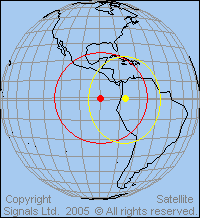 All earth stations on that red line have the same elevation angle and slant range to the satellite. If you measure the delay and it corresponds to that line then you know the site is somewhere on the red line. If you make a similar measurement using a wrong (yellow) satellite further along the orbit, the site must then be at either of the two points where the circles cross, one in the northern hemisphere and one in the southern hemisphere, on the same longitude. Detecting the signal on the wrong (yellow) satellite is difficult - improbable yes, but not impossible. Given that you have a copy of the wanted signal (via a dish aimed at the normal satellite) you correlate this with the noise from the wrong satellite and gradually slide along till you find a correlation peak. You need a big dish and some clever signal analysis skills and it is possible to detect the bursts. So, if you really want to find the location of an uplink interferer it is possible - possibly expensive and complicated, but not impossible. If I was running an Hughes NOC in the US, I would suspect any site with an unusually short slant range to be in either Mexico or on one of the Caribbean Islands. Location in S. America would be less likely in view of the coverage beam. Best regards, Eric. |
|
Nov 1st, 2006 at 12:26pm
OK I will change impossible to "extremely highly improbable and expensive" Hows that? I mean maybe if you were Osama and they were looking for you...but to see if you had a unit operating in Cuba....no way But once again, not to beat a dead horse until it's a greasy spot on the side of the road. You do not need the cooperation of anyone at HN or Spacenet to locate a unit wherever you want in the footprint and therefore how can they be held liable in any case if you decided to put your unit in Cuba? Whew! |
|
Nov 1st, 2006 at 3:58pm
Your "delay" and "triangulation" methods reflect some thought on the matter, but unfortunately you're trying to apply terrestrial DF methods to orbital telecommunications. For the specifics of ultimately locating an individual transmitting unit, you'd have to contact Homeland Security and/or NSA (good luck). What little I can tell you involves known signal properties relative to known footprint characteristics (contour mapping) of any given transponder. As far as what can be done right at the NOC - defensive measures are as simple as blacklisting, or in some cases remotely disabling an offending transmitter. They don't even HAVE to know where it's located. For determining location, in some cases they need only remotely extract the geoloco from the modem's memory. When internal methods are insufficient to obtain a desired geoloco, all they need is a MOU with the government - and a phonecall. I am not concerned with liability - never even mentioned it. So I must assume you were directing that last thought at another contributor. //greg// |
|
Nov 2nd, 2006 at 12:48am
|
|
Nov 2nd, 2006 at 4:19am
they would not be under obligation to turn the signal off unless they new for a fact that it was not a lagitimate system being used by the base or one of the soldiers on that base. Concur //greg// |
|
Nov 2nd, 2006 at 4:45pm
"Pgannon was venturing that you would need the cooperation of the NOC to locate a VSAT in a particular area and that is simply not the case." Hmm. That's not quite what I said. When I jumped into this discussion, it was only to point out that in my opinion the network operator might bear a higher level of responsibility than was suggested. Some time ago I was contacted by an Iranian who repeatedly pressured me to help him import VSAT hardware and services into Iran. He had all the angles - ship to UAE, etc. I was pretty sure this was illegal, but I didn't know the details. I contacted the Dept. of Commerce and spoke with a couple agents. The feedback I got back, in a nutshell, was that the network operator could end up bearing a significant burden of proof that they did not participate in illegal activities. "Turning a blind eye" so to speak, is not a valid defense. I post a warning comment in this forum every time I see someone mention that they can bring US-based technology into proscribed countries like Cuba, Iran, Syria, Sudan and N. Korea. For US companies, there are large fines and jail time to consider. Companies, US or otherwise, who are discovered importing hardware or delivering services to these countries, will find that their service and reseller contracts with the US vendor are likely to be canceled immediately. Illegal exports breach most US contracts, and the US vendor cannot tolerate this breach of contract if they wish to avoid large fines and/or jail time. To show they weren't involved, they would have no choice but to cut the reseller off cold. No service. No support. Is that worth the risk? Probably not! I expect that most people are simply uninformed about the export laws and are not actively looking to break the law. Re Guantanamo, that is US soil as long as the US holds the lease, so there's no issue. The same generally applies to embassies. For example, you can't sell a system to Cuba to use at their embassy in France, but you can sell to the French State Dept. to use at their embassy in Cuba. The best source for information regarding exports of US goods and services is here: https://www.bis.doc.gov/ I don't work with the lower end residential services such as Starband and HNS, so I can't comment on the ability to identify the site from the NOC. It's my experience that most higher end systems do in fact keep track of the location. The tighter and more advanced the signaling, the more necessary it is that the correct location be known to avoid time-outs and SCPC errors, etc. My point is simply that if a network operator discovers a site in the middle of Cuba on their network, they better look into it. They would actively be breaking the law if they worked with the customer to identify a fake latitude/longitude in order to hide the actual site. Most customers wouldn't be able to do this without help. This is an academic discussion. Surely nobody who participates in this list would attempt anything illegal, right?!!! Nod your head up and down, folks! Pat |
|
Nov 2nd, 2006 at 6:04pm
Yes this was just an academic discussion among satellite geeks and as such I found it rewarding and I think everyone came away from it a bit better informed...I know I did. |
|
Email me:eric@satsig.net |