|
Jan 30th, 2007 at 8:24am
If your nominal polarisation is vertical the starting position for the polarisation setting is with the broad faces of the LNB waveguide on top and underneath, like so:
 . .
If you completely rotate the feed assembly all the way round (if that is possible) then there are two opposite positions when you achieve vertical polarisation.
See here two examples of vertical polarisation
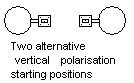
Look at the tiny squares showing the LNB waveguide flanges and you will see the wide faces of the LNB waveguide on top and underneath - this is vertical polarisation. An alternative vertical polarisation angle start position is with the LNB on the opposite side. It does not matter whether the pin in the LNB waveguide is at the top or the bottom broad face.
Sometimes, if you have a large polarisation angle adjustment to make (like 75 deg) it is necessary to choose the best starting position, as from one of the start positions it may not be possible to reach the final required angle because the LNB or BUC hits the metal arm or support yoke.
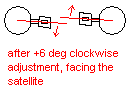
In your case, step 2 is to make a polarisation setting adjustment of +6 degrees. While facing towards the satellite rotate the entire feed 6 deg clockwise. Lay an inclinometer sideways across the BUC or LNB or use the tiny (but crude) scale on the horn throat clamp. +/-1 deg accuracy is required.
This is what it might look like after +6 deg clockwise adjustment, while facing towards the satellite:
Now raise the antenna elevation to 48.6 deg using the elevation scale behind the dish, swing the dish boldly sideways in azimuth in the general direction of due south and you should find the AM1 satellite.
Good luck, Eric
|