|
|

| SatSig Topics Index › Dish pointing and alignment › Site survey for uplink antenna |
SatSig topic: Site survey for uplink antenna(Read 6226 times) |
|
May 8th, 2007 at 8:18pm
Any suggestions would be welcolme regarding what equipment is needed to carry out an RF survey. I do know that Eric carried out a survey for an ex employer of mine. Regards Union |
|
May 8th, 2007 at 9:15pm
Contact your radio regulatory agency and complete a licence application. They will need to know your frequencies, feed power spectral density, antenna off-axis emission envelope and horizon profile plot. They will tell this information to nearby users of the same frequencies to allow them to co-ordinate with you to resolve any interference issues. For a receive site, a simple interference survey may be done with a feed horn, an LNB and spectrum analyser. Just point around in all directions and see what signals are visible. Record everything carefully and do both polarisations. Note that the gain of your feed horn (e.g. +10dBi) is comparable with the off-axis gain of your big antenna (perhaps +5 under the beam and -10 dBi round the back - typical - see your dish off-axis sidelobe envelope formula). Be warned however that quick a look like this may miss serious but intermittent interferers. How long are you willing to test for ? Leaving a spectum analyser on peak hold helps but I would prefer some modern analyser with periodic downloads to disk. Coming in on a monday morning to see the screen full of interference won't tell you that it all occurred in a few seconds when the site boss started his car at 5.30pm Friday. I did a page recently about earth station site shielding using dual edge diffraction plus foliage RAM (radio absorbant material). wxw Best regards, Eric. |
|
May 10th, 2007 at 7:22pm
Thanks for your reply. I have attached a link to the location of the proposed 3.8m uplink/Downlink antenna location https://en.wikipedia.org/wiki/Three_Rock_Mountain as you will see the site is one of the main locations for transmission for Dublin and surrounding areas. The antenna will be used with an iDirect private HUB set-up. Therefore the HUB will TX in L band to the 8W BUC Uplinked in KU band with the RX being Downlinked KU band to LNB then L band to private HUB. What would you suggest as a minimum time spent in the field with a spectrum and wave guide/feed cone LNB also I take it that the best option would be to fix the test setup in position on antnna pointing AZ and EL? Kind regards Union |
|
May 10th, 2007 at 8:43pm
added later: If your iDirect hub and BUC needs 50ohm cable use that type, of course. On your receive side the concern is that there might be interference either into the dish in Ku band (10.7 to 12.75 GHz) or into the cable directly. Both are unlikely unless you are really close to the radio systems. You could test with a feed and LNB or even a satellite TV dish and point it at the masts and see what you can see on an analyser. Regarding timescale I would say that few minutes should be sufficient for 90% confidence, 3 hours should be sufficient for about 95% confidence, 24 hours for 99.5% and a week for 99.9% confidence. Military bases and radar may generate intermittent interference as may ships sailing past. Local interference can occur if cell phones are held right next to the modem or when motors or heaters are switched on and off. When using a spectrum analyser take great care not to apply 14 or 19 volts DC to the input socket if it is not designed for this. It can cost £1000+ to mend the input stages of the analyser. I would recommend you call the people who look after the masts and speak with their person responsible for frequency coordination and discuss. I expect they will be helpful and informative, as will your radio regulatory office. Don't worry, they are there to help you. Why don't you test with a 1.2m dish or similar and an iDirect modem, pointed at the wanted satellite, at your proposed 3.8m dish location ? If some serious problem is evident it is then easy to move without a big cost implication. You might be interested to know that we operate almost underneath some massive medium wave transmitter masts where we have fence gates that spark at night. We have everything well earthed, use optic fibres or heliax for all cross site cables, and copper floors, walls and ceilings. Looking back on things the satellite and radio aspects have been easy, it is the router configuration, traffic management and VoIP that have taken the most time and effort. Maybe because we are new to all this IP stuff  Best wishes for your iDirect hub, Eric. |
|
May 11th, 2007 at 5:59pm
Thanks for taking time to look at my secanario, the iDirect equipment and BUC/LNB are all F/type connectors @75 ohm impedence. iDirect are specifying RG-6 the cable run need to be less than 120ft for IDU to ODU due to driving the 8w buc at 24v dc. And yes it is well under 200m to nearest mast. I have attached a link to a photo of the site  as you can see there are a multitude of possible interferance sources. I do not have a 14Ghz spectrum so maybe a second visit with this equipment may be advisiable in the long run, dependent on if I can even get a clear LOS. as you can see there are a multitude of possible interferance sources. I do not have a 14Ghz spectrum so maybe a second visit with this equipment may be advisiable in the long run, dependent on if I can even get a clear LOS.Regards Union |
|
May 11th, 2007 at 8:24pm
https://www.broadbandutopia.com/100febedupls.html This one features triple shielding: a foil, a braid and a further foil with a shorting fold. Sounds good. Do be very gentle with such cable and treat as fragile. Don't make any sharp bends in it, even for a moment. I have taken old cables apart and discovered large numbers of cracks and splits in foils due to pulling and bending during handling and installation. An 8 watt BUC will take quite a current so try for a short cable run and use a voltage towards the upper end of the design range to keep the current down. If the voltage at the BUC is too low the BUC output capability will be limited and the signal quality degraded. To determine line of sight you can get the dish pointing angles here: https://www.satsig.net/maps/satellite-tv-dish-pointing-uk-ireland.htm Is this your site ? 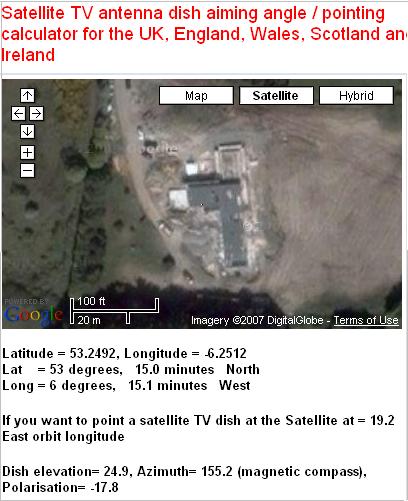 wxw Best regards, Eric. |
|
Aug 17th, 2007 at 7:02pm
 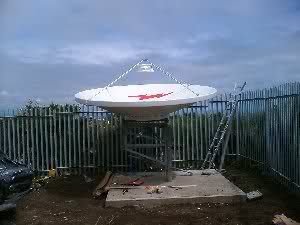 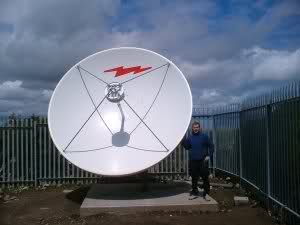 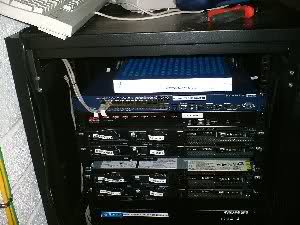 Union |
|
Email me:eric@satsig.net |