|
Nov 11th, 2007 at 12:18am
If you are operating now with circular polarisation you will have a polariser between the feed horn and the OMT. The feed horn is the conical part nearest the dish. The OMT (otho-mode transducer) is the joint where the circular or square waveguide to the horn transitions to two rectangular waveguides, normally one for transmit and one for receive. The polariser is a long section of square or circular tube with two rows of pins or slots along opposite sides.
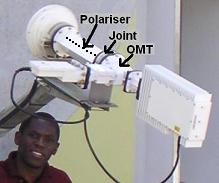
In the case of circular polarisation the polariser needs to be set so its lines of pins or slots are at 45 deg to the transmit and receive waveguides. There are two alternative positions, at 90 deg to each other. One gives left hand circular polarisation on receive and the other gives right hand circular polarisation on receive.
In the case of linear polarisation you can remove the polariser. Then turn the feed for the correct polarisation starting position and then apply the adjustment angle, as for Ku band. Alternatively you can achieve linear polarisation by keeping the polarariser and turning the OMT relative to the polariser so that the receive and transmit waveguides line up with the pins/slots. The polariser effect, which is to slow down one of the planes becomes irrelevent. The existence of the polarisaer has a minimal negative effect on signal quality. At least you won't risk losing it while in storage. You still need to set the polarisation starting position and adjustment, this time you need to rotate the entire assembly.
Best regards, Eric,
|