|
|

| SatSig Topics Index › iDirect Forum: hubs and terminals › Interference Issues |
SatSig topic: Interference Issues(Read 9500 times) |
|
Apr 2nd, 2008 at 11:53pm
I had this problem while i was trying to align a 1.8m dish on AMC 12.The site is an existing site but the modem had to be upgraded to a 3100 series. The problem now is that the modem refuses to lock even after i had changed the LNB several times and i now finally noticd that when i stand by the left side of the dish as if i am creating an ark beside it and reflecting the waves back to the feedhorn the voltage suddenly jumps to 16 and when i leave it goes bak to 2v.What kind of a solution can one prescribe to this problem |
|
Apr 3rd, 2008 at 5:27pm
I would also ask your network operator to send you the ABCD string test to make sure the dish is not warped. I believe there is also a string test on Satsig that you might want to try. |
|
Apr 4th, 2008 at 11:22am
I can imagine this is a C-band or extended-C system? Is it in Abuja or Lagos?? If yes for both questions, I would go for wireless inteferences. Maybe when u stand next to the dish you block some of the interferences, that otherwise saturate the LNB. Regards, Nimrod |
|
Apr 4th, 2008 at 12:05pm
Yes the site is in lagos and what string test mite u be talking about pgannon? |
|
Apr 4th, 2008 at 12:38pm
If you have a spectrum analyser, carry the LNB (or LNB and feed horn) in your hands and point it around to see where the interference is coming from. Metal walls perfectly stop the interference going through, but the top edge (a metal conductor), is visible from both sides and acts as a receiving and transmitting antenna. It takes in the interference and retransmits it. This is called knife edge diffraction and a metal edge is the worst case. Concrete is better; resistive earth bank, wet wood, plants, evergreen bushes and trees are best. Hiding the dish as low down as possible is a big help. Regarding dish distortion: Most satellite dishes, including offset types, are supposed to have a flat front rim. The sides of the dish may get pulled forwards due to the weight of the feed assembly. You can put tight fishing lines up-down and across the front. There should be no gap where they cross. ref: https://www.satsig.net/vsatflat.htm Some dishes have two short side struts at the back to help stop the sides being pulled forwards or pushed backwards. ref: https://www.satsig.net/pointing/rear-side-struts.htm Some Prodelin dishes have a bolt which may be inserted between the feed arm and the lower edge of the dish plus a joint with the spine assembly at the lower rear. In these cases the joint between the feed arm and the lower end of the spine must take the full load, not the focal length reference screw into the dish, which can stress the bottom edge of the dish backwards. The screw should just drop in freely. Prodelin can provide ABCD measurements which refer to the distances: A from bottom of the feed horn to the bottom of the dish, B from the top of the feed horn to the bottom of the dish, C from the bottom of the feed horn to the top of the dish and from the top of the feed horn to the top of the dish. wxw Best regards, Eric. |
|
Apr 4th, 2008 at 12:43pm
Could be complicated to find a place clear of the interferences. I once made a site survey in VI and my spectrum looked like it is going to blow up from all the noise around. It was saturated even when I put the LNB under cars in the parking lot. only when I blocked the LNB waveguide with my hand it disapeared (then I realized the ammount of radiation people over there are exposed to every day...). For your question about which material - anything that blocks signal - i.e. zinc plates or whatever metal. Wet wood will do as well, but you wouldnt water it all the time i suppose. You can try to put sombody next to the dish when you need the service or you can try to install filter on the LNB. |
|
Mar 11th, 2009 at 7:30am
i'm having a similar problem... what kind of filter can be installed on the lnb??? mine is a 1.8 mtr dish on ku band thanks |
|
Mar 11th, 2009 at 8:36am
If you have same frequency Ku band interference from a nearby terrestrial source then you need to use site shielding to reduce it. Obstruct the interference path or move the dish. If you have local Ku band interference that is not at the wanted frequency but is within the LNB input range (10.7 - 12.75 GHz) and is overloading or saturating the LNB then site shielding is preferred or, as a last resort, a front end Ku band filter can help. With regards to filtering, it is essential to use a spectrum analyser to investigate this problem first as getting a special waveguide filter made for the situation will be expensive. It is conceiveable that a tuneable notch filter could be made to deal with one interfering carrier that is not close to the wanted carrier. Best regards, Eric. |
|
Mar 11th, 2009 at 9:10am
My dish seems to be ok, it has actually been up and running for the past 3 months. We suspect that it may be intereference either from a nearby GSM, or CDMA network or wifi network, we are not really sure what the source of the interference is... Secondly, we have a very serious space constraint, the dish is actually on a about 15 foot platform, so relocating the dish is a very difficult option... What kind of filter can u recommend? do you think it will solve the problem? Thanks alot |
|
Mar 11th, 2009 at 9:34am
A new satellite cross-pol interferer carrier may have appeared recently that only now shows up that your cross-pol has not been well aligned for a long time. Similarly, a new high power carrier from an adjacent satellite. Having the dish high up does make it difficult to point. Has the dish become mispointed due to wind etc ? Best regards, Eric. |
|
Mar 11th, 2009 at 10:18am
What can i do about a possibly new cross-pol inteferer carrier that just appeared? does it have to do with my polarisation???? Thanks alot for your prompt reply |
|
Mar 11th, 2009 at 10:48am
Once set correctly, you should not then be affected by carriers on the opposite polarisation, or cause interference to others. If there were no carriers operating on the opposite polarisation at the time of the original installation and your polarisation set up accuracy was say 10 deg in error you would have seen no problem. However once someone starts to use the opposite polarisation transponder you suddenly experience interference. This is only one possibility to explain the sudden drop in your receive performance. Corroded LNB cable connection, antenna moved or water in waveguide are more common. Best regards, Eric. |
|
Mar 11th, 2009 at 12:05pm
It's not very easy to sort out my problem because im not the immediate sat guy. The sat guy is saying that the polarisation is not applicable in my case because on the provider we are all using one downstream carrier.... is this accurate??? He says something about this only affecting SCPC while we are on TDMA.... i really don't get his explanation... right now we are talking about getting a transmit reject filter or getting a smaller 1.2m dish and setting up on the ground... Another question i'd like to ask is that can power lines cause an interference, as in electricity cables running parallel with the lnb cable connections???? What are you thoughts??? Thanks alot |
|
Mar 11th, 2009 at 12:37pm
The sat guy is saying that the polarisation is not applicable in my case because on the provider we are all using one downstream carrier.... is this accurate? He says something about this only affecting SCPC while we are on TDMA.... i really don't get his explanation... If the satellite beam down towards you operates on one polarisation only then there will be no downlink cross-pol interference, now. But the satellite could be changed to become dual polarisation at some future time, so it is best to get it right. The outlink carrier (from the hub to you) is normally a large continuous, multidestination, carrier, similar to MCPC or SCPC. Your uplink transmissions are normally intermittent bursts, called TDMA. Is your problem poor reception at your site of the outlink continuous carrier from the teleport hub?. I would wonder if other sites receiving this same carrier also have any problem ? Quote: right now we are talking about getting a transmit reject filter or getting a smaller 1.2m dish and setting up on the ground... A transmit reject filter is always needed at a two-way VSAT site and it is located between the OMT junction and the LNB input. Its purpose is to protect your LNB from interference from your own BUC transmissions. Without a TRF every time you transmit a burst it will cause errors in your receive side or even damage your LNB. I would certainly like to experiment with a 1.2m dish on the ground. Quote: Another question I'd like to ask is that can power lines cause an interference, as in electricity cables running parallel with the lnb cable connections? This is a controversial matter. From the lightning safety point of view, the antenna structure should be earthed at the antenna location. If the BUC/LNB is actually connected via its clamps to the antenna structure (this varies, sometimes the support arms are via the plastic dish) then there is the possibility of mains loop currents superimposed on the coax cable supplies. Be careful if you suspect this, as AC voltages sufficient to give a shock, may appear at the ends of the coax cables. Never hold the antenna/BUC/LNB in one hand while touching the end of the coax with the other hand. Best regards, Eric. |
|
Mar 11th, 2009 at 3:14pm
So far, we tried changing my feed horn to some different feed horn and changed my power to -17 and we where able to get a lock. we have snr of about 6.18 The dish is still up high on the platform... What do you think about this? Secondly, i don't seem to have a reject filter installed. Do you think it will improve things??? Thanks alot |
|
Mar 11th, 2009 at 7:17pm
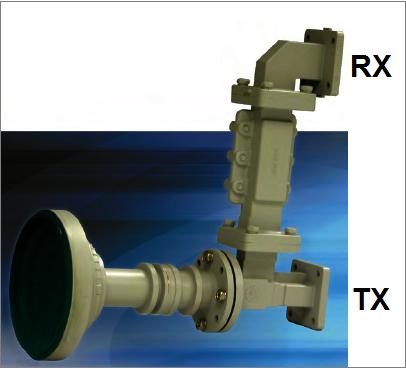 The transmit BUC connects at the straight through central waveguide. If the TRF part is omitted the receive side (LNB) may fail whenever the BUC transmits, due to interference from the BUC into the LNB. The type of feed horn should match the f/d ratio of the main dish. Dishes with f/d=0.8 need a larger diameter feed horn compared with dishes with f/d=0.6 The diameter d is the side to side diameter of the dish. The focal length f is the distance from the lower edge of the dish to the phase centre inside of the feed horn (approx). The BUC power needs to be correct. Too low and you will not transmit sufficient power. Too high and you will overdrive the BUC and send a distorted signal that won't work either and cause interference to other people. It may also damage the BUC transistors. The power setting, e.g. -17 dBm, varies with length of the TX cable. The iDirect hub will eventually set your BUC power to the clear sky operating point to get a C/N=9dB TDMA reception at the hub, and which will allow for some automated increase during rain. Have you set the polarisation angle ? Best regards, Eric. |
|
Email me:eric@satsig.net |