|
|

| SatSig Topics Index › iDirect Forum: hubs and terminals › I can change the carrier |
SatSig topic: I can change the carrier(Read 3708 times) |
|
Apr 5th, 2008 at 6:05pm
|
|
Apr 5th, 2008 at 10:10pm
I think your question needs to be addressed with your provider. Only they can tell you what networks they have, the minimum RFT requirements for those networks, and what the service plans look like for those networks. |
|
Apr 6th, 2008 at 7:46am
my subscribing is star sharing 1:10 plz give me webpage abut topolgy network internet satellite |
|
Apr 6th, 2008 at 12:44pm
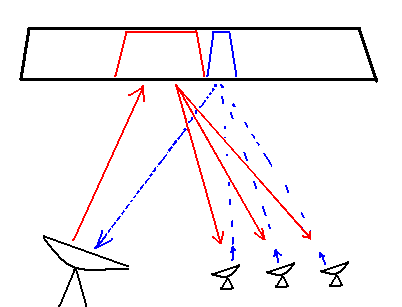 A simplified star network is illustrated above, involving 3 remotes. The large teleport hub transmits a continuous download carrier (red) to all the remotes. Within this carrier are packets of data intended for each remote site. The remote sites transmit intermittent short bursts of data, interleaved in time, and these bursts are received by the hub, using one receiver. If you have 10 customers then you might put all 10 on the same return link. On average, each remote can transmit for less than 10% of the time. It is possible to have several return links, in which case there will be multiple return link burst receivers at the hub. A star network has a large hub dish and small remotes. 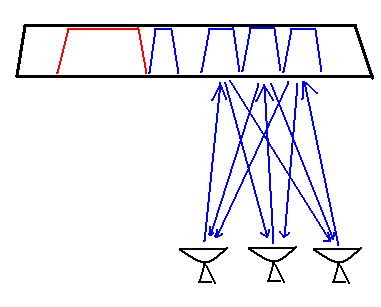 Mesh networking (illustrated above) allows direct communications from one remote site to another. The dish sizes all need to be larger and similar in size. Assuming SCPC (continuous carrier) operation, each site will need one modulator and two receivers. More complex systems are possible with dynamically demand assigned carriers, set up just for brief periods when one site needs to call another. Such networks are called mesh DAMA (Demand Assigned Multiple Assess). A pool of frequency is used and as traffic demand requires carriers are created and removed. For example for a phone call or large file transfer. This required that one of the sites acts as a controller hub to manage the spectrum and instruct remote sites to change transmit and receive carrier frequencies and capacities at a moments notice. An overlay low capacity star network may be used to do this, giving the hub a low bit rate management control of all remotes. If remote sites have minimal equipment, just one transmitter and one receiver then during mesh operation they are lost from the network control and must retune back to the hub immediately once thier site to site communication is finished. Direct mesh connection improves the quality of phone calls, as it avoids double hop delay. The penalty is more equipment and expense. DAMA needs a lot of management effort. Dedicated SCPC mesh networks, with many small carriers, are difficult to fill efficiently, but do provide a simple, very reliable, high quality solution that does not depend on real time managment supervision. Best regards, Eric |
|
Apr 6th, 2008 at 1:23pm
1. You provider must have a full mesh or integrated mesh network populated and commissioned in his hub. 2. You must have a PLL LNB on your remote system. 3. You must have a 5000 or 7000 series satellite router as the units 2nd demod is required to see your TDMA loopback. 4. You need an M1D1 ULC for your Tx card at the hub. 5. You need an aperture conducive to a mesh link budget as well as the RFT equipment (BUC/HPA/SSPA) to use mesh. Mesh payload (remote to remote-TDMA) requires significantly more power to close a remote to remote link in a TDMA mesh inbound. G/T changes in mesh! You are no longer routing through the Earthstation large antennas at the Hub/Teleport. 6. The teleport must be in the beam (Hub must be able to see its own SCPC looback). This is a prerequisite to the 1st requirement up top. If the Hub has a full mesh or integrated star/mesh network populated in their 5IF, then they have obviously done their homework and have met the minimal requirments to stand up a mesh network. Although mesh payloading does not traverse the hub, the hub still sets timing, BW assignment (IP payloading via SADA and SANA processes) and assists with fade conditions (UPC on the hub side and UCP on the remote side which is managed by the PRI NMS). I have done integrated star/mesh with as little as 2.4M apertures. So it can be done. It is very important to have a provider run the link budgets for mesh as the power requirements are radically different from star topologies (no secret there!). What I really like about iDirects integrated star mesh is that if fade is detected on one of the remotes, the mesh payload will revert back to star payload (thus traversing the hub) which will keep the link up to the remote that is not under fade. Now, iDirect is allowing integrated spread spectrum and you can put a SS inbound in with other topologies. Very powerful. Did I mention you can do it with TRANSEC! Expect to see about a 400ms difference in RTT with mesh. ICMP in star (remote to remote) was 1200ms and after I commissioned to mesh the ICMPs were right around 700-730ms. I love it. |
|
Apr 7th, 2008 at 10:13am
|
|
Email me:eric@satsig.net |