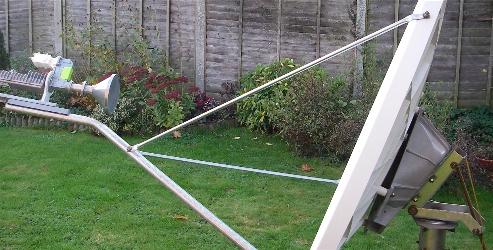
My aiming parameters for my location, Kirkuk, Iraq, before hooking up the Horizon meter, are as follows:
System: HX 50
Satellite: W6
Azimuth: 212 degrees (magnetic)
Elevation: 42 degrees
Skew: +29 degrees
Here is the background and detail, along with some specific questions:
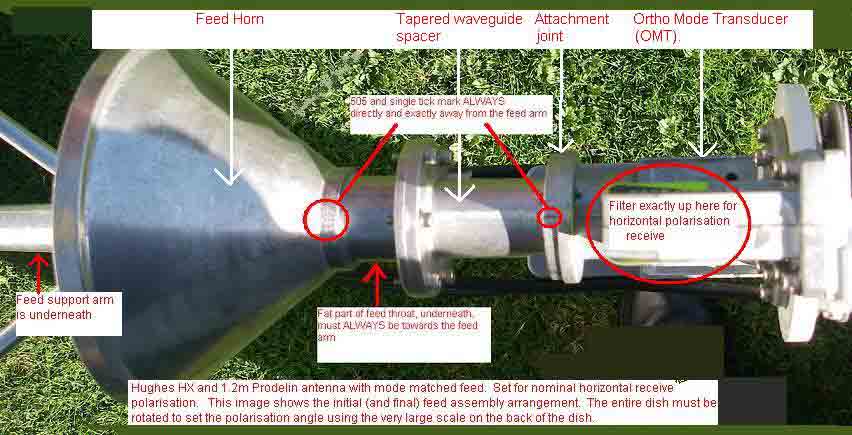
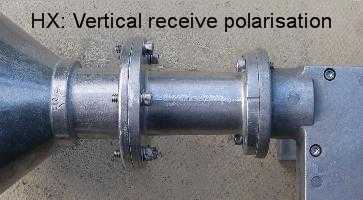
(1) Receiver/Transmitter assembly: I was told by Bentley Walker that the polarity of the assembly should be VERTICAL for my dish in Iraq aiming at W6. Looking at the assembly instructions that came with the product, it shows in section 3 that the side port (with the small white box attached to it… what I believe is called the “filter”?) should be oriented exactly AWAY from the feed arm for a vertical polarity set-up. Reading through the posts, here, though, that seems to be misleading… it appears that, for polarization discussions, the following applies:
a. During the initial set-up, most all discussion of polarity refers to RECEIVE polarity, not TRANSMIT polarity.
b. The assembly instructions have therefore labeled the diagrams incorrectly; that is, for vertical polarity, one needs assemble the “505” on the top of the horn assembly directly AWAY from the feed arm, keeping the single score mark also AWAY from the feed arm and rotate the rest of the transmitter/receiver assembly in its yokes to 90 degrees, which makes the side arm stick out to the left or right (depending on whether you rotate the transmitter/receiver assembly POSITIVE 90 degrees or NEGATIVE ninety degrees).
Added by forum admin: Yes, you are correct. The Prodelin assembly manual is ambigious and misleading. The page about polarisation is in terms of the transmit polarisation. I have written to them about this.
(2) Horizon meter: I am connecting it as follows: using the coaxial cable-30 meters- that I bought with the HX 50 system, I connect one end of the marked cable to the female connector coming off of the little white box on the side port (the “filter”?). The other end I connect to the Horizon meter, at the input female connector. Then I check my initial dish alignment using a magnetic compass and a tape measure as a makeshift inclinometer like Eric describes (very helpful). Then I start sky sweeps (most of the time I do this after the sun sets). When I sweep the sky carefully, I get variations in signal strength… (particularly if I am doing the sweeps during daylight hours) which I think is good. In fact, at certain points in the sky, I get strong signal peaks. My received signal as I read on the Horizon meter (I think the units are dB?) stays on 56 as just random background signal, but at certain discreet points, the signal peaks abruptly to as high as 78. I have been able to find about 3 discreet points in the sky where the signal gets strong like that. BUT I NEVER GET A “SATELLITE FOUND” MESSAGE. I talked with Bentley Walker technical support, who emailed me an updated load for the Horizon meter, specifically for the W6 satellite. I loaded it, and now I have about 10 different W6 selections to choose from on the Horizon meter. Bentley Walker tells me I should be using #6.
Questions:
-The Horizon meter instruction manual instructs that I should use a very short length of coaxial cable to connect the Horizon meter to the transmitter/receiver assembly. Bentley Walker told me, however, that that is not important and that I can use the 30 meter cable that was bought with the whole HX 50 package. Is it OK to use the 30 meter cable when using the Horizon meter?
-Are my aiming parameters (azimuth, inclination, skew) correct?
Yes
-Is my understanding of assembly for vertical versus horizontal polarity correct?
Yes
-If I am seeking the W6 satellite, do I need to be set-up for vertical or horizontal polarity?
-If I am correct in the conclusion that for vertical receive polarity, one needs to rotate the transmitter/receiver assembly 90 degrees, then do I rotate NEGATIVE 90 degrees, or POSITIVE ninety degrees? (as read off of the scale on the transmitter/receiver yokes)
Added by forum admin: Nominal vertical polarisation is when the dipole pin inside the LNB waveguide is vertical. The broad faces of the LNB waveguide will be on top and underneath. With the LNB arm sticking out sideways (relative to the ground) you will have a nominal vertical starting position. It does not matter which side. In some cases, applying the adjustment angle will make the LNB hit metal, in which case start on the other side.
-I haven’t even connected or powered up my modem, for fear of messing it up. I think I don’t need to do anything with the modem until I get a nice solid “satellite found” message on the Horizon meter. Is that assumption correct?
Once you connect the low voltage DC multiway cable between power supply module to the modem never disconnect this multiway DC power lead. Always power off at the mains before connecting or disconnecting the coax cables
-Any additional advice for how I can find the W6 satellite?
-Anyone else using HX 50 and W6 satellite in Iraq? Any recent installs of such a set-up that could provide some advice to me?
Many thanks to Eric. Great information here. Eric, I sent you some photos of my set-up.
-Very Very Novice
US Army
Kirkuk, Iraq
Images inserted by admin
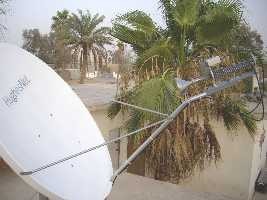
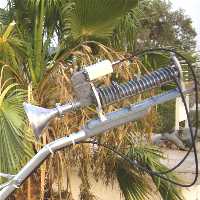
View of HX dish. Feed assembly good. Horizontal polarisation. It is not obvious from the camera angle if any polarisation adjustment has yet been applied.
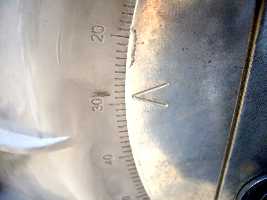
+29 deg clockwise polarisation angle applied.
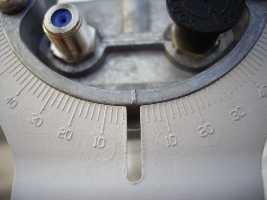
Correct assembly orientation of the BUC. Horizontal polarisation. Adjustment should NOT be applied here.