|
Feb 4th, 2009 at 11:09am
Yes, please send close up detailed photos of the feed assembly and the joints, from many directions.
An accurate side on view of the entire dish and feed might help also so that distances A, B, C, D from dish edges to the feed edges can be measured from the image. Have the camera in line with the front face side edges of the dish.
At the circular/square joint between the polariser and the feed horn it is important that the joint is accurately centered and straight. Normally the screws will force the centering to be accurate but if there is any slack then you must carefully make sure that the two parts line up, like to 0.001 inch. Regarding straightness, there may be a circular gasket. The screws need tightening evenly so that the thickness of the gasket is the same all around. The gasket itself must be central and not misplaced sideways.
At the rear end of the polariser, where the OMT attaches, the linear polarisation waveguides should be at 45 deg to the polariser pins/slots. Normally the screw will make his accurate.
As you have replaced a Ku band feed with a C band feed there is scope for doubt about the position of the feed horn, relative to the dish. Did you need a new feed support arm or side structs ? If the distance from the horn to the dish is wrong or the feed horn is sideways from the focal point of the dish, you will suffer low gain and cross pol problems.
Do you have documentation about the antenna showing pictures of the C band feed arm and dish so you can assess if the feed is in the correct place and pointing towards the center (or a fraction above the centre of the dish ? What is the manufacturer and model number of the dish and feed parts?.
Do you have a transmit reject filter installed between the OMT and the LNB? Is it the right way round ?
The polariser should be straight. Bending it or squeezing it in the middle will alter the cross-pol. The weight of the OMT/BUC/LNB may be bending it down. Does is need a support at the back end? You could try rotating the entire feed assembly to various angles. It should not make any difference but the weight change might make it bend better, or less! Make sure the yoke clamps are gently tight. If you screw them down too hard you will squash the tube and make an unwanted polariser.
There should be no loose screws or washers inside anywhere. Lumps of grease at the flanges/gaskets should also be avoided.
You could try attaching the OMT to the polariser at 180 deg to its present position. It should not make any difference, but it might.
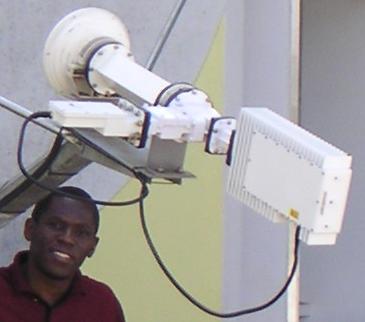
Picture of someone else's C band circular polarisation feed assembly:
Best regards, Eric.
|