|
Jan 28th, 2009 at 11:21am
If the situation is serious you should immediately turn off all remote sites that are working with that line card. Stopping the interference to others is more important than ceasing your service temporarily.
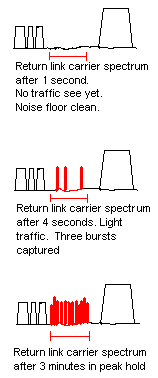
If it is just one bad site out of many, watch the return link cross-pol spectrum as you may be able to see the modulated interference bursts. Look in the gap, if any, between the traffic carriers on the opposite polarisation. If the interference bursts are frequent and repetitive set the analyser to zero span and you may be able to turn off one site at a time till the bad spikes disappear. it helps to artifically generate even traffic levels from all remote sites. Try setting a ping -t running on each site.
Make a list of all the sites on the return link together with the cross pol values measured when you lined them up.
For each site in turn, test it by moving the return link frequency to a cross-pol test frequency and measuring the cross pol level. Do this for every site on the list and write all the results down. As you test them, reactivate sites with acceptable cross-pol, exceeding 28 dB.
Now you have a list of bad sites remaining. Contact each one and get them to adjust their polarisation angle while you monitor their CW carrier on the cross-pol frequency. Reactivate sites once they pass.
To avoid the problem in future be more strict with the installers and make them adjust the polarisation to the centre of the narrow null more carefully.
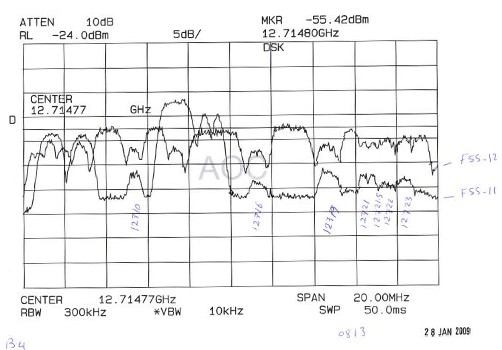
Forward the spectrum plot (fss chart) to me eric@satsig.net for more advice.
Best regards, Eric.
|