|
|

| SatSig Topics Index › Satellite Connection in Africa › Need help Installation Vsat C Band |
SatSig topic: Need help Installation Vsat C Band(Read 14923 times) |
|
Apr 9th, 2009 at 2:22pm
I am installing a VSAT 1.8m near Viana, Angola I Use 1.8m antenna 1 c band lnb Nortsat 1 Buc Norsat These are my coordinates: -9.00173881783833 Latitud 13.51043701171875 Longgitud I'm doing alignment: Satellite: NSS 10 Orbital position: 37.5 ° W Distance to satellite: 38703.45km Beam: C-band Europe / Africa Beam Azimuth angle: 97.31 ° Elevation angle: 31.24 ° LNB Tilt (Skew): 78.4 ° My problem is with that orientation i cant find any signal !!!! What i'm doing wrong ??? Thanks for your help... |
|
Apr 9th, 2009 at 5:31pm
 At this moment i only know that is Dual Linear. But i'm not sure... I dont know if it help ... |
|
Apr 9th, 2009 at 7:57pm
Your angles should be something like: Beam Elevation = 31 deg (error corrected here) Azimuth = 289.5 deg magnetic (this is approx west, where the sun sets.) Polarisation = -78.4 deg. We don't know your receive polarisation name so we will try Horizontal first and if that does not find anything then change to Vertical and try again. Polarisation setting: 1. Set nominal. Rotate the feed till the LNB is at the top. This is the nominal horizontal polarisation receive starting position. 2. Apply -78.4 deg anti-clockwise rotation as viewing towards the satellite. This is a large change, but is correct. The LNB will now be on approx the 10 o'clock position as viewing towards the satellite. Elevation: If there is a scale set 31 deg. If no scale read the instructions. With an offset dish, when you set the front face vertical the beam elevation angle will be the documented offset angle. If offset was 22.6 deg then you would need to tilt the front face backwards by 8.4 deg. If you need an inclinometer read how to make an inclinometer. Azimuth: Just swing the dish boldly from south west to north west and you will find the satellite with 50% chance. If not found, turn the feed 90 deg for the other polarisation (LNB now about 1 'clock position with you facing towards the satellite). If your modem has been correctly tuned etc it should lock up when it received the wanted carrier. Readout the signal quality. Spend at least 30 minutes peaking up. Best regards, Eric. |
|
Apr 10th, 2009 at 3:22pm
We use NSS-10 satellite in C-Band in DVB-S2 for terminal Satlink model. Our frequency is 4.061884 GHZ and symbol Rate: 3.014200 in DVB-S2 mode. What downlink polarisation name to receive? Linear Vertical What uplink polarisation to transmit? Linear Horizontal |
|
Apr 10th, 2009 at 7:44pm
A normal C band LNB has a local oscillator frequency of 5150 MHz, so the tuning in your modem needs to be 5150 - 4061.884 MHz. Set spectrum to "inverted". Use other data you have been given to set symbol rate, FEC, IP addresses etc, whatever you have been told by your service provider. Feed system polarisation setting: 1. First set to nominal. Rotate the feed till the LNB is at one side. This is a nominal vertical polarisation receive starting position. 2. Apply -78.4 deg anti-clockwise rotation as viewing towards the satellite. This is a large change, but is correct. The LNB will now be on approx the 1 o'clock or 7 o'clock position as viewing towards the satellite. Stand behind the antenna and look north-westwards, viewing towards the satellite. It will be easier to set up the polarisation while the elevation angle is lowered so that the feed system is easily accessible. Use the correct angles for your location. See earlier messages above. Best regards, Eric. |
|
Apr 11th, 2009 at 7:09pm
I use the inclinometer and set up 42° Beam Elevation. And in my spectrum analyzer i found 99% signal in Azimuth = +/- 292 But when I connect the cable from the lnb to satlink, nothing happens !!! I have one STM Linksat 1000. And my provider send me these command's: dvb tx autostart off odu antenna 5 odu lnb 85 odu txtype 0 odu txlo 73750000 odu txdc 1 dvb rx autostart on dvb rx fwdlink 0 0 3014360 4061884 dvbs2 2 dvb pos lat 9 2 28 1 dvb pos long 13 34 55 0 dvb pos alt 152 ip set 3 10.10.40.95 255.255.255.0 ip dns server 217.15.32.2 217.15.32.34 sw license nat XkblWV********** sw license pep QFgvVV********** (ERROR) ip nat enable ip nat global add 81.85.224.3 ip pep enable trans (ERROR) save config I already try Polarization at 1, 7, 10 and 3 o'clock. And its the same !!! |
|
Apr 11th, 2009 at 9:06pm
https://neohosting.jalawave.net/~iyus/SatLink_Terminals_Getting_Started.pdf (2.9 Mbytes pdf file) This and additional details about the command line interface should be on a CD that comes with the modem. The command line interface (CLI) includes some cryptic codes referring the options in pull down menus of the web interface regarding LNB and BUC types, model numbers, hemispheres etc. The modem will take care of the calculations to convert satellite frequency to modem frequency - but the selections of LNB and BUC model types must be input correctly. I would follow the instructions to use the CLI and then open up the web interface to see if the saved config makes sense and to get familiar with the Satellite - Status - Receive SNR screen. Regarding the spectrum signal you have detected. If there is no change with polarisation rotation then you are either looking at the correct satellite and there are identical signals on both polarisations (unlikely) or you are looking at a wrong satellite with circular polarisation. I would set the polarisation correct and try the next satellites up and down. The LNB will now be on approx the 1 o'clock or 7 o'clock position as viewing towards the satellite. Stand behind the antenna and look north-westwards, viewing towards the satellite. Are you using an elevation scale on the bracket behind the dish to set the elevation ? What is the slope of the front side edge of the dish?. Best regards, Eric. |
|
Apr 13th, 2009 at 11:41pm
Unfortunately I'm not had success. Here are some photos to see if everything is well: https://4.bp.blogspot.com/_N6bS1KmuVos/SeO02LZmCZI/AAAAAAAAAjk/JSTUxTLNWKo/s1600 -h/4.jpg https://3.bp.blogspot.com/_N6bS1KmuVos/SeO0aK1BAUI/AAAAAAAAAjc/nBnKWKcWCpg/s1600 -h/3.jpg https://3.bp.blogspot.com/_N6bS1KmuVos/SeOtRisXQyI/AAAAAAAAAjU/JlmKzGsKYpg/s1600 -h/2.jpg https://1.bp.blogspot.com/_N6bS1KmuVos/SeOsHNfj3YI/AAAAAAAAAjM/lo9E1SqAdQ8/s1600 -h/1.jpg 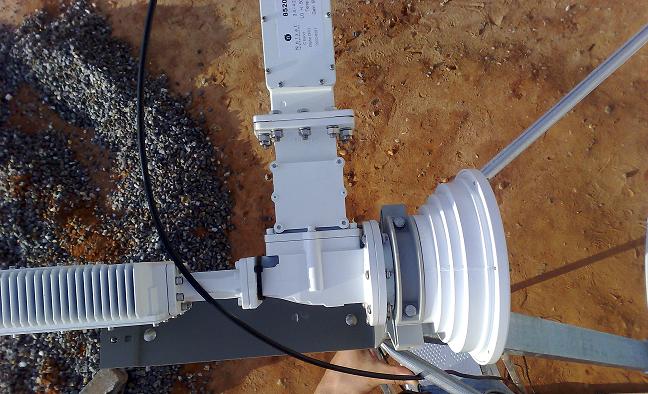 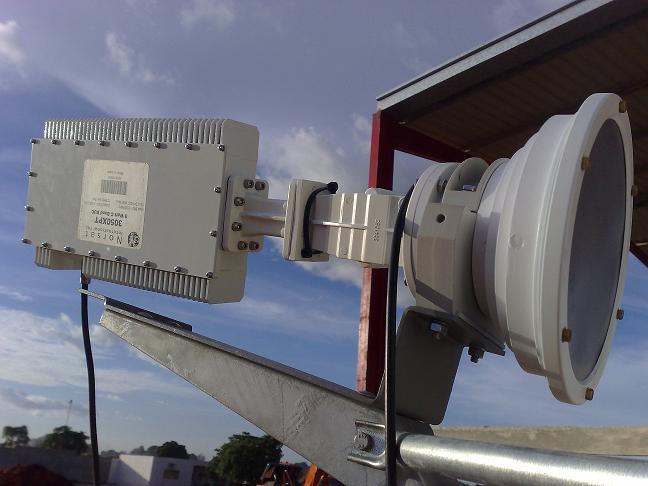 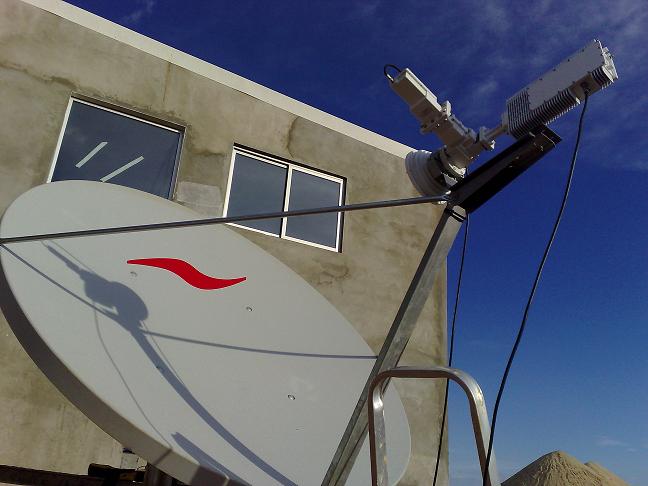 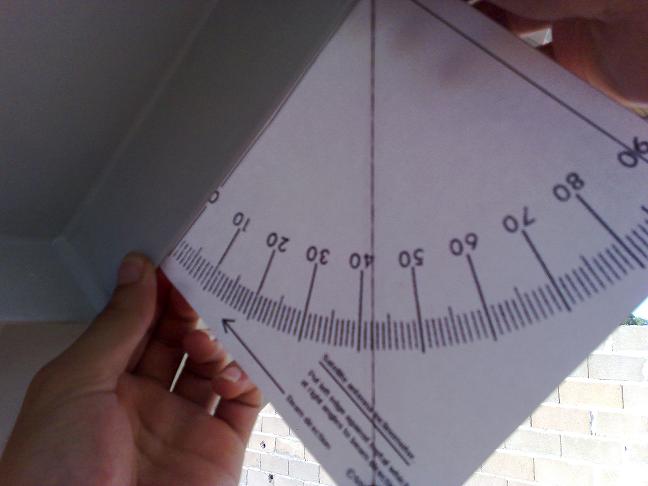 Actually there are any Vsat C-Band installer in Luanda to help ? with payment combine. I have urgency !!! |
|
Apr 14th, 2009 at 8:25am
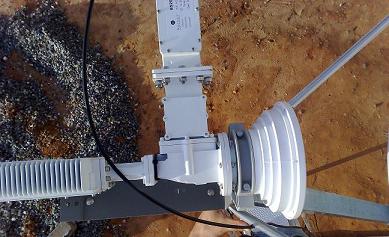 You have the LNB in approx the 2 o'clock position, while viewing towards the satellite. It looks like you have turned the feed only about -15 deg anticlockwise. For vertical receive polarisation and a -78 deg adjustment you need to start with the LNB at the side and then turn it anticlockwise by -78 deg. It will then be in approx 1 o'clock position - with you behind the dish and FACING TOWARDS the satellite in the sky. It looks like you need to turn the feed assembly further anticlockwise. ie. LNB upwards till it is much nearer the top, in fact 12 deg before it reaches the top. If there is a scale on the horn or feed throat you can use the tick marks to count the amount of degrees, but ignore any +/- signs or numbers, which may go backwards etc. Elevation angle: 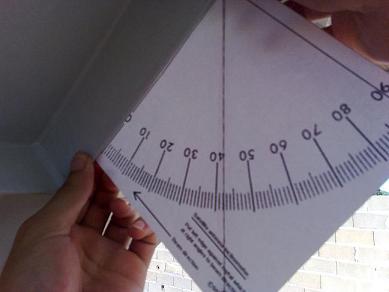 Well done making the inclinometer. It is very accurate. I do wonder however if you have applied it correctly. Yours is an offset dish and when the front face of the dish is vertical the beam elevation angle is the same as the offset angle. If you have applied the inclinometer to plastic that is in the middle behind the dish then the angle you should be setting will be more like 8.5 deg. (beam elevation minus offset angle, e.g. 31 deg minus 22.6 deg). Do the dish instructions mention the offset angle or say if a particular part of the plastic or part of the metal mount is at right angles to the beam direction?. Is there an elevation scale on the bracket behind the dish ? 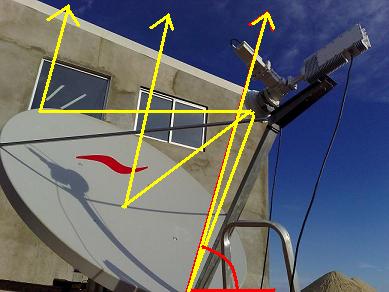 I've drawn lines showing approx where the beam goes now. It looks rather more like 60 to 70 deg beam elevation. It is hard to tell from the camera angle. It helps to take the picture from an exact side view so the camera is in line with the front side edges of the dish. My guess it that you need to reduce the elevation angle by a large amount. I've just had a look again at the calculations for elevation angle and I now get: 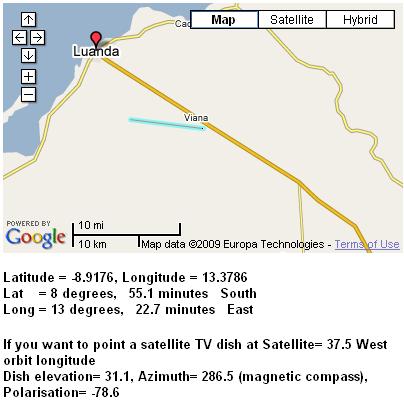 Elevation = 31 deg, Azimuth = 286 deg and Polarisation -78.5 deg. For 31 deg elevation try setting the back of the dish at 8.4 deg. I'm guessing a 22.6 deg offset. Sorry about wrong elevation angle (42 deg) above. Your 31 deg was correct. I have amended above. The satellite is still to the west north west of you, not east like 91 deg azimuth. Best regards, Eric. |
|
Apr 15th, 2009 at 5:36pm
Elevation angle: To answer your question if i applied it correctly. You can see in this picture. https://3.bp.blogspot.com/_N6bS1KmuVos/SeYHRBT6fDI/AAAAAAAAAjs/zOQXmTr9ih4/s1600 -h/Andrew+1.8m.jpg 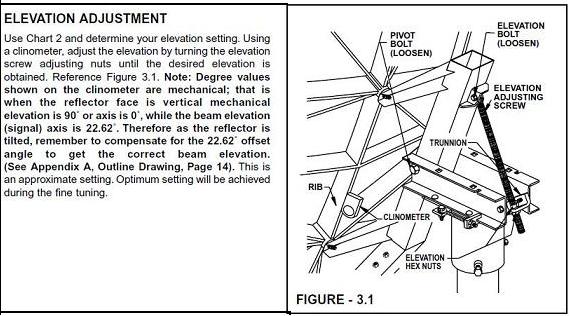 Whit is: Elevation = 31 deg, Azimuth = 286 deg and Polarisation -78.5 deg. For 31 deg elevation try setting the back of the dish at 8.4 deg. I'm guessing a 22.6 deg offset. I only find a circular signal !!! |
|
Apr 15th, 2009 at 6:27pm
You have applied the inclinometer in the correct place. Note that the dish offset angle is 22.62 deg. This means that for a beam elevation angle of 31 deg you need to tilt the top of the dish backwards only slightly, by 8.4 deg in the inclinometer scale. If you have the wrong satellite, go up and down to the adjacent ones above and below and try them. Have you lifted the LNB upwards, compared with your LNB picture above. The LNB should be up -78.5 deg anticlockwise from the right hand sideways starting position (Starting position name = Vertical nominal polarisation). You must view from behind the dish, facing towards the satellite in the sky. The LNB will finish up betweeen 12 o'clock and 1 o'clock position. It was at 2:30 o'clock in your picture above. You are welcome to turn the feed by 90 deg at any satellite to see what happens. If the satellite is circular polarisation there will be little change. Best regards, Eric. |
|
Apr 21st, 2009 at 2:05pm
Already found the problem! The problem was the modem. I had to update the firmware and was everything ok. But the connection is very slow I have a package of 1024/256kbs and i only can download 90kbs. What could be? Thanks one more time for your help and your time
|
|
Apr 21st, 2009 at 2:47pm
If it really is as slow as 90kbit/s then maybe you are shared 10:1 with other sites and the network is busy. Check with your Satlink service provider. If you are sold a shared 1024/256 kbit/s you should be able to receive at up to 1024 kbit/s for a proportion of the time. Are you sure you are measuring bits/second and not bytes per second ? (8 bits per byte) Best regards, Eric. |
|
Apr 23rd, 2009 at 12:54pm
Sorry i put the wrong value in the post, the download is 10KB/s and i write 90kbytes per second, but I talked to my provider and it is their problem in HUB. I need urgent provider for NSS10 C-Banda, someone can help me? |
|
Apr 25th, 2009 at 9:37pm
Afriglobal Comms has Bandwidth avaialbe on NSS10 and i also have someone in Lubumbashi who could assist with the installation contact me on chris@afriglobal.co.za |
|
Email me:eric@satsig.net |