|
Feb 11th, 2010 at 5:39pm
Intelsat 906
In the lower part of C band range 5850/3625 - 6298/4073 MHz operation is in hemi (red) and zone (yellow) beams. Hemi is pol A. Zones are Pol B.
In the upper part of C band 6298/4073 to 6425/4200 operation is in Global beam, Pol A and Pol B.
Pol A is LHCP up and RHCP down.
Pol B is RHCP up and LHCP down.
RHPC TT&C beacons appear at 3047.5/48/52/52.5 MHz.
A linear tracking beacon is at 3950 MHz. The linear tracking beacon will be visible to both circular polarisations.
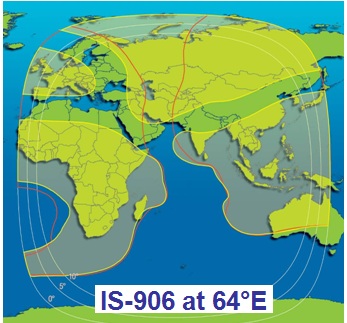
In mid Africa you are in south west zone (B pol) and West Hemi (A pol).
Find out from your service provider what beams and polarisation types you are supposed to be using.
Cross polarisation is normal in the intelsat system but co-pol is not impossible.
For cross pol operation, your feed must have an OMT and the transmit and receive waveguides will be at right angles. If you are receiving the correct carrier then you will transmit on the opposite polarisation. If you cannot find the wanted carrier then take your OMT to polariser joint apart, turn the OMT by 90 deg so that it 45 deg the other side of the line of pins/slots inside the polariser and reattach. One way will work perfectly. The other way not at all. If you can see any TT&C beacons, either side of the linear tracking beacon then you are on A pol, with RHCP down.
If you are operating in SW zone (B pol) you cannot operate in any of NW, SE and NE zones because they don't point at you. You could operate in Global B, but it would be expensive as a worldwide anywhere to anywhere connectivity is at a premium. Dish size alsi needs to be larger. If you wanted to operate in West Hemi (A pol) or Global A you would need a 4 port feed (as used at many teleports) or switch the feed over, or set up another antenna on the opposite polarisation feed.
Best regards, Eric.
|