|
|

| SatSig Topics Index › Dish pointing and alignment › EB/NO on 1.5 M Swedish 1.5F/A |
SatSig topic: EB/NO on 1.5 M Swedish 1.5F/A(Read 7718 times) |
|
Mar 28th, 2010 at 4:45pm
Question: Is it normal for the receive Eb/No to go down once crosspol is done? If not, what could be the cause of this? Thank you all for any help on this issue. Bob |
|
Mar 28th, 2010 at 6:14pm
The final optimisation of the polarisation should very slightly improve your wanted receive signal and reduce the interference your transmit signal causes to others significantly. Possible reasons for 2 dB drop in receive quality: There is some problem with LNB or BUC cable connectors such that the LNB supply voltage is lowered when the BUC is activated. Open circuit outer sheath on one cable is a possibility. The transmit carrier is leaking into the LNB input. Could be due to poor transmit reject filter. Are you using unusually high power BUC ? The output of the BUC contains spurious transmit signals in the receive band. Could be due to overdriven BUC causing spectrum spreading and spurii all over the place. The transmit carrier is on an adjacent transponder frequency slot to wanted receive carrier. The carriers are too close together or the transmit carrier spectrum contains spectral regrowth (BUC overdrive) directly interfering under the wanted receive carrier. There is some major power supply problem. When the BUC is transmittting the increased BUC current taken is reducing the main power supply voltages in the modem and it is no longer working properly. Is the BUC power supply adequately rated ? Does the 2 dB reduction occur if the tx carrier is turned off or reduced in level by 10 dB?. Does depowering the BUC make any difference ? All below here is probably irrelevant.. If you have spectrum analyser you can peak up your receive polarisation by finding some cross pol carrier opposite to a clean part of your wanted polarisation and making careful exact equal measurements either side, say aout 20 deg off, then halfing the angle. Could there be any loose metal nut, water drops, or other matter (e.g. spider) inside the OMT or feed system ? If the antenna comprises a single offset reflector does the feed point just a fraction above the centre of the dish? If there is a subreflector then the mechanical alignment of everthing is very sensitive and critical. Best regards, Eric. |
|
Apr 3rd, 2010 at 1:44pm
I REALLY appreciate your comments. I can say that I can discount many of your suggestions due to the fact that I get the same condition on two identical, but completely separate systems. So, problems with cables, LNB, BUC, etc seem to be ruled out. Power supply is suspect to some extent. Power comes from a large facility generator. However, both systems were plugged into two different building power sources. I will investigate that. The TX and RX frequencies are of course the same between the systems. So your comment quoted below peaks my interest a bit: "The transmit carrier is on an adjacent transponder frequency slot to wanted receive carrier. The carriers are too close together or the transmit carrier spectrum contains spectral regrowth (BUC overdrive) directly interfering under the wanted receive carrier. " I am not sure I understand exactly what you are saying. Are you saying that if the downlink frequency to the teleport is too close to the downlink frequency from the teleport then it could cause a problem? I will try to explain better. The outbound service from the teleport TX is on freq A, and the downlink (remote rx) is freq B. The return service from the remote is freq C and the downlink (teleport rx) is on freq D. What is the proper separation in frequency between these frequencies? If freq B and D are too close I could be ok just peaking up on freq B, but then once I start transmitting it could effect freq B if freq D is too close to B? Clear as mud!  Can you rephrase this part of your response? I think I have 17.799Mhz between both rx frequencies. I will attempt to do the other test of turning off the BUC and see what happens. Thanks for the help! Bob |
|
Apr 3rd, 2010 at 2:26pm
The normal frequency spacing between two adjacent carriers is 1.4 x half the symbol rate of carrier A + 1.4 x half the symbol rate of carrier B. If you look at the two adjacent carriers there should be a clear null, almost down to the noise floor between the carriers. If the null between the carriers is only 3 to 8 dB deep I would say it looks like the carriers are too close together. If you lease the whole spectrum then you can decide your own spacing between your carriers, trading your adjacent carrier interference for bit rate. If a BUC is overdriven, e.g. trying to transmit 3 watts with a 2 watt BUC, the effect is spectral regrowth, as shown in the image below: 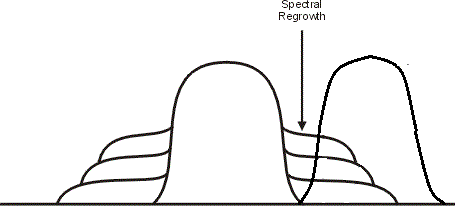 The carrier on the left (overdriven BUC) interferes with the carrier on the right. If the carrier on the right were much narrower, while remaining close up alongside the interfering carrier the interference effect would be worse. Note that operating a BUC with overdirve may destroy the output transistors - permanently ! If you are interested to see interference (if any) turn off the wanted carrier and look to see that there is a clean flat noise floor underneath. If you can see what looks like distinct humpy carriers underneath your carrier then the interference may be cross-pol, intermodulation or adjacent satellite. Best regards, Eric. |
|
Apr 3rd, 2010 at 2:39pm
I simply blame the phenomenon on less than professional grade hardware. It's mass produced stuff, reflectors and feeds that are a result of the least expensive engineering effort required to pass minimum FCC/ITU regulations. So my own analysis is that the problem we both witness is likely little more than the effect of irregular reflective surfaces combined with a less-than-optimum feed angle //greg// |
|
Apr 3rd, 2010 at 2:48pm
I've just had a look at some Swedish pictures and they show dual reflector Gregorian designs. This design should, in theory, give excellent cross-pol results, but it is extremely sensitive to slight relative misalignment of the three parts (dish, subreflector, feed). Best regards, Eric. |
|
Apr 4th, 2010 at 3:41pm
An instance of this happening was due to a transmit reject filter being mounted the wrong way round. The image below shows the transmit reject filter in its correct configuration: 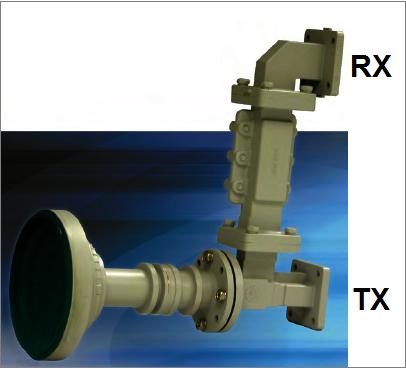 Note that the reflective (stop) filter element is not in the middle of the length of the filter waveguide. The parts OMT, filter, waveguide bend and LNB must be joined as shown, including the orientation of the filter. Other sequences like OMT - bend - filter - LNB do not work properly and give too high cross-pol when tested. I speculate that the distance from the OMT junction to the reflective filter element and back to the OMT junction matters as this is the path followed by any spurious 14 GHz energy in the LNB side arm being reflected back to the OMT by the filter. It would be interesting to see a picture of the feed system of the Swedish antenna. Best regards, Eric. |
|
Email me:eric@satsig.net |