|
|

| SatSig Topics Index › Dish pointing and alignment › Need Help in pointing a Large Dish |
SatSig topic: Need Help in pointing a Large Dish(Read 12009 times) |
|
Apr 29th, 2010 at 9:27am
My problem is that the dish has a fixed azimuth which is going to prove a little difficult to €œswing freely€ when trying to locate the satellite. I have done the calculations and the dish should be pointing at 188.78 True North (184.59 Magnetic North). What I am looking for is any suggestions hints/ tips on how I can move this €œmonster€ delicately 1° at a time and with the minimum risk or serious injury to myself, when I have to finally position the dish accurately! I have so far assembled the base and the frame to hold the panels, and have pointed it as close to the correct azimuth. But with all the metal in the frame it may be slightly interfering with the compass. The weight now is just about manageable, so before I add the panels I would like to be as close as possible. Any suggestions would be appreciated! A couple of minor questions - the focal point for the LNB is 1470mm, when measuring this distance, is it to the front of the feedhorn? (Invacom Quad). Also I am going to need 23 meters of cable from the lnb on the dish to receiver and I know that once you go over 20 meters there can be a loss in quality of signal. Any ideas of how much the signal will be degraded? Thanks in advance for any help suggestions. McD |
|
Apr 29th, 2010 at 12:39pm
Emailed you a couple of pictures. Elevation NOT a problem, have adjusting bolts for that (Will be 49.62° for information). |
|
Apr 29th, 2010 at 4:23pm
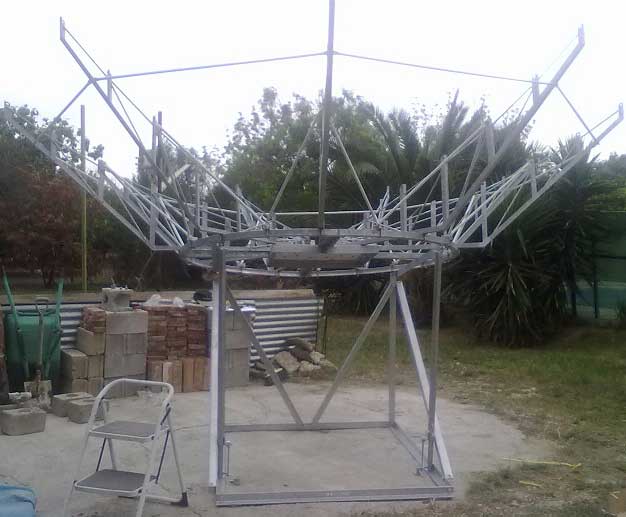 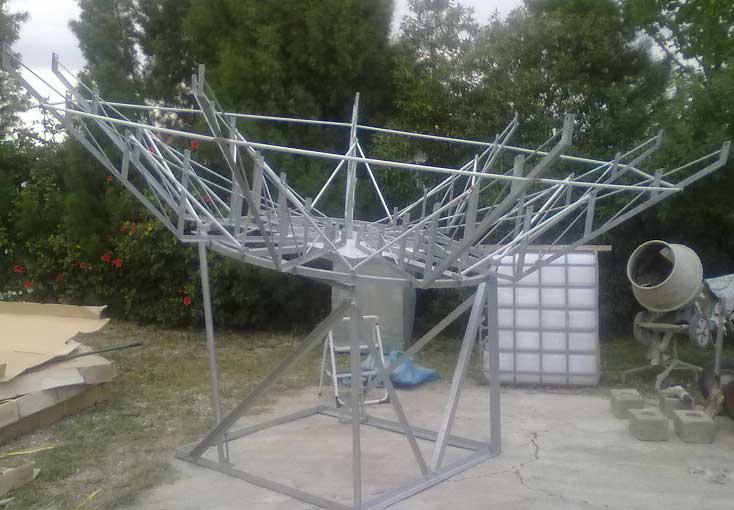 If anyone has seen a mount like this and knows how to implement the azimuth adjuster, please say... Regarding the LNB. It needs to be the type with a small aperture, intended for use with front fed, short F/D circular dish. Many LNBs, with larger conical feed horn apertures, are intended for use with long F/D ratio offset fed dishes. Email Invacom to ask where is the phase centre relative to the front face of the LNB. Feeds for short F/D ratio dishes typically have a simple circular waveguide tube with some external scalar rings around. Phase centre is in the middle of the aperture or few mm inside. The scalar ring on the outside may be adjustable for different F/D ratios. The idea is to spread the power suitably across the full diameter of the dish. Feeds with wide diameter horns, intended for long F/D offset dishes, may have a phase centre near the aperture or many cm down inside, depending the horn flare angle and frequency. Best regards, Eric. |
|
Apr 29th, 2010 at 6:35pm
You need a circle of steel profile( rail) under it so that you can turn the mount over the rail. When you pointed to the right satellite you need a clamp to fix itto the rail. Good luck |
|
Apr 30th, 2010 at 1:43pm
I also think that some parts may be missing, but if it is for Rx only, and you are just looking for simple solution to make it works, I think it wouldnt be a bad idea to fix the basement at one point only to the concrete slab using an anchor bolt. Do not tight the bolt, so it will be used as an axis. Then, you can tie a rope to the diagonal corner or even better, two ropes, one for each direction and with any kind of pully pull the rope slowly till you get the bird. It is really not the official way to do it, but if it is just for Rx only dish and you just need it to be good enough, I think this way will be quite simple and safe as well. Good luck and please dont forget to tell us how did you manage eventually! 
|
|
Apr 30th, 2010 at 3:56pm
If the monopod is on its own at the back, it forms the elevation adjustor. If the bipod apex is at the side, and the bipod legs fore and aft then adjusting the two legs in opposite directions gives a limited range azimuth adjustment. The above arrangement, with all 6 legs adjustable (e.g. using bottle screws) is a patented method for positioning an object (XYZ), using the tripod, and also orientating it (X'Y'Z'), using the bipod and monopod, whilst at all times remaining tight and rigid. e.g. for subreflectors and in precision optics. Quasi-universal joints such as spherical rose joints at the ends of the struts is one implementation. You must have the base rawl-bolted into the concrete to prevent it falling over or blowing away during construction ! Once panels are attached the wind will catch it ! Ropes are also a good idea, as above. Attach the ropes to secure anchors, e.g. trees or proper stakes. Read about using fishing lines in a triangle across 3 rib ends so as the get all the rib tips in a flat plane across the front of the dish (+/-1.5 mm if possible for Ku band). Parabolic dish panel adjustment. It is possible to do this test prior to attaching the panels. Once panels are on, repeat. Then adjust to the operating elevation angle and do a simple 2 fishing line test, up/down and sideways. If the dish goes saddle shaped consider putting it back to zenith and predistorting in the opposite directions. - all assuming there is some adjustment possibility. Even if not, the sequence of gentle and gradual tightening of all attachment point is really important. Best regards, Eric. |
|
May 3rd, 2010 at 11:17am
I have one fixed bolt at the rear of the frame and have to manually move the frame. It does move but with some effort. As I said previously moving it 1° at a time delicately is my problem. Trying to get Astra 2D at 28.2° East. Was getting a strong signal but unable to get a lock on the bird. As I was about to quit for the evening it locked onto ArabSat at 26.2°. So I have done the calculations using Eric's Satellite finder, and I am out by 3.45° and my elevation off by 0.34°. Will try tomorrow to get the right satellite. McD 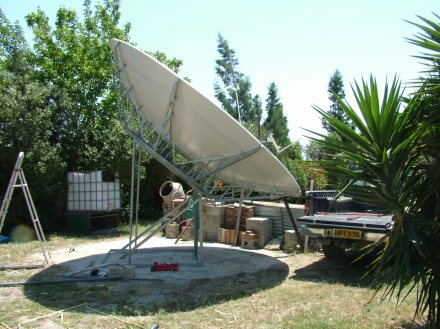 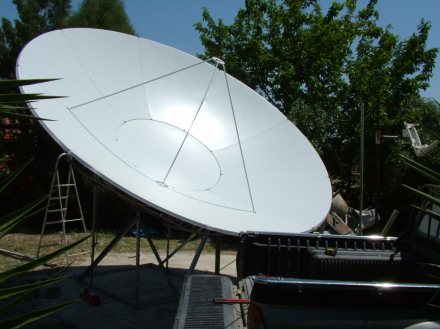 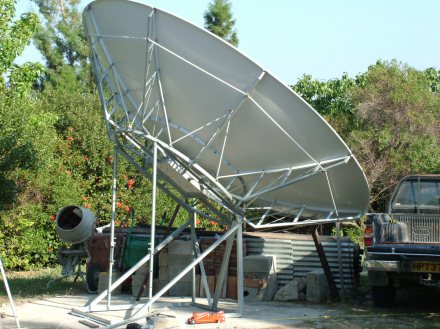 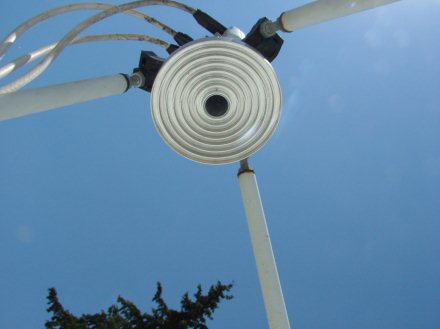 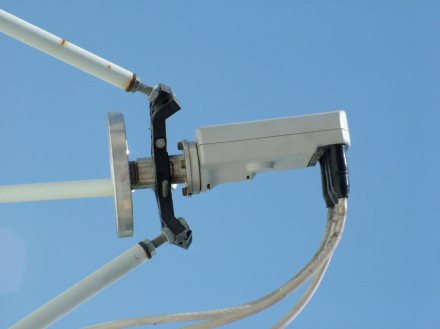
|
|
May 13th, 2010 at 11:07am
I also have a 3.2 dish (less than 15 meters from the new dish) pointing at 2D (the 4.2 is replacing same). It is locked on and I am receiving a good strong signal. So I have used the inclinometer to set the 4.2 at exactly the same elevation, but now all I need to get is the dish pointing at the right bird and get a lock. My question is: How do I set the right azimuth without the use of a compass? and/or using the 3.2 as a guide. With the elevation it was easy, I know I am close but it is quite hard to move in small increments, (especially with the lacuna problems mentioned above.) Note for Eric: I tried your suggestion about using Arabsat as a guide, BUT I found that I could move the dish 3-4 centimeters in either direction and still get a lock! Any help would be appreciated. Thanks McD |
|
May 13th, 2010 at 1:22pm
Move the 4.2m dish so as to duplicate the shadow position, at the same time. The sun moves 1 deg in 4 minutes so don't wait before starting the adjustment of the big dish and try to make it quickly. Keep looking back. When the sun's shadow is exactly above or below the feed is a good reference but this only occurs once per day. You can make reasonable 'duplication of the relative positions' at any time - but a bit more approximate. The joint lines between the panels may help if both dishes use the same number of panels. If using centre fed axi-symmetric, circular, dishes this method solves both az and el simultaneously. If the relative positions of the shadows match, both dishes are pointing to the same direction. 2. If both dishes have similar rectangular ground bases, you might stretch a tight string between the two bases. The angle between the string and the sides of the rectangular iron frame gives the azimuth angle. Best regards, Eric. |
|
Email me:eric@satsig.net |