|
May 17th, 2010 at 2:59pm
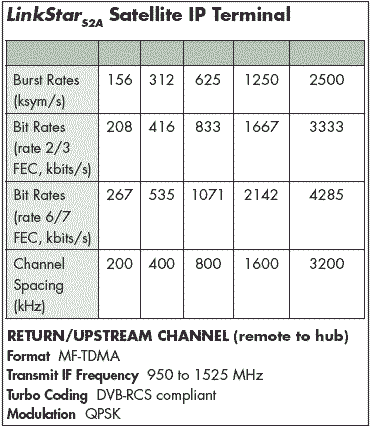
The bit rates above, for two different FEC rates, refer to instants when the transmission is on. Data throughput on a return channel depends on the percentage of time that the channel is active. TDMA burst length, guard gap times between TDMA bursts, average TDMA burst length and burst headers and checksums all need to be taken into account. When there is random TDMA access you need to leave a lot of time space unused or you get excess collisions.
The most efficient operation is achieveable when the return link is configured as dedicated for one remote site only (same as SCPC). The least efficient is when the traffic comprises just occasional random short burst mouse clicks from very many sites. If the traffic comprises large files then the NMS will assign a proportion of TDMA time slots in pre-assigned mode, together with full length long bursts, which will improve the efficiency.
Regarding transmission rate:
Symbol rate = 2500 ksps.
QPSK = 2 bits per symbol.
Transmission rate = 2 x 2500 = 5000 bit/s.
Using 6/7 FEC rate,
Information rate = 5000 x 6 / 7 = 4285 kbit/s
Best regards, Eric.
|