|
Nov 21st, 2010 at 10:03pm
Before doing that study the manual and also record the current pointing, both on the controller and also on the physical scales. Do you have manual handles ready in case you break the motor drive system?.
When you put it back to automatic make sure you are within 5 dB of the beam peak (i.e. on the main beam) and not on a sidelobe. Watch it for at least 30 minutes to make sure it really is peaking up properly and is starting its learning process again.
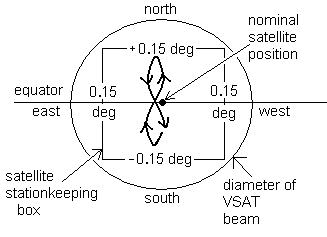
To track manually it helps to have a spectrum analyser tuned to the beacon frequency in zero span with 30 min sweep time so you have a graph of the level. Use a resolution bandwidth that is much wider then the frequency drift. You can do this to monitor the step track operation and watch the zig-zag and exploratory steps. See if you can get the controller to display/print out a log of its activities.
Be very careful. Tracking systems on a large dish like yours involves high voltage motors, powerful drive mechanisms, soft and hard end stop limits etc. Mistakes can be fatal, especially at heights, in the dark, rain, snow, high winds etc. It is quite possible for the controller and drives to do very strange things, like suddenly mispointing the antenna a very long way from nominal for no obvious reason. Wear a hard hat.
I hope the above does not sound too alarmist, but I speak from experience. Tracking is a good example of a case where the maxim "If it works, don't fix it" applies.
Best regards, Eric.
|