|
|

| SatSig Topics Index › Satellite Internet - Europe › NordNet Offer Free Satellite Equipment |
SatSig topic: NordNet Offer Free Satellite Equipment(Read 9486 times) |
|
Jan 27th, 2009 at 9:49am
Last year, the French government launched its Plan France Numerique 2012 which basically stated that every French household should have access to the Internet for less than 35€ per month and at a speed of 512Kb/s. The Orange/Nordnet package will go a long way to making that plan a reality because the satellite covers 100% of the territory and there are around 500,000 homes which can't get broadband by conventional means. [broken link] https://www.nordnet.com/fp/FP_pack-satellite.pdf Installation of the NordNet system can be performed by Orbit Home Technologies all over France. info@orbit-direct.com 0553914652. |
|
Sep 29th, 2009 at 10:29pm
If youre just a user who switches on every other day for email, you wont notice. Carl. |
|
Sep 29th, 2009 at 10:44pm
The original post is misleading as it should say that this is shared system, with speeds of up to 2048 kbit/s. It is therefore misleading spam advertising. Be warned. Readers should be aware that 2 GBytes over a month is equivalent to an average of only 6.3 kbit/s. You only get what you pay for. Satellite bit rate is a very expensive commodity. The advertised service appears suitable for perhaps 1 PC, used rather less than average. It is helpful that an extra 1 GByte may be optionally purchased. Typical PC users on a shared system, need at least 10kbit/s average and should be paying at least $70 per month. Best regards, Eric. |
|
Oct 3rd, 2009 at 9:34pm
could you please explain what a shared system is. I am right in thinking this is something to do with the interactive speed rate for browsing and not just how fast you can d/l a file. Also, I take it that 1.7 Gb received is 1.7gb whether it be satellite or adsl connection. I monitor my use carefully with 2 sets of software and have done numerous checks. Nordnet continually record me as using nearly double the amount. That is why i ask the question. Thanks, regards carl. |
|
Oct 4th, 2009 at 11:12am
The outlink carrier (download data flowing from the internet towards all the customer sites) may be 1 Mbit/s, but ALL the sites do their downloading via this fixed total capacity. If there are 100 sites then the long term average download speed per site cannot exceed 10 kbit/s. At rare times when only 1 customer is on-line the download speed might be 1 Mbit/s, but when a second customer starts downloading simultaneously the speed drops to 500kbit/s for each and so on. During the day download speed will vary from second to second, according to the number of active sites. The cost of the service is inverse to the number of sites sharing. So 100 sites might each pay $70 towards the 1 Mbit/s total. Alternatively a business customer, operating a community ISP (Iraq, Afghanistan, Africa etc) with 100 local wired or wireless customers, might buy 1 Mbit/s in dedicated SCPC mode and pay $7000 per month. The community ISP is not sharing its satellite capacity with anyone else, but the ISP's 100 end-user customers are sharing the 1 Mbit/s. Shared systems use TDMA return links towards the teleport hub. All sites transmit on the same frequency, but only one site at a time with each site transmitting very brief bursts - so time shared. In this satsig.net forum I am very strict that there should be no suggestion that shared services will give data throughputs comparable with dedicated services. The cost of shared service may be 100 or 1000 times lower than dedicated service, but so is the throughput. You simply get what you pay for. Shared systems normally have some kind of fair-access-policy (FAP) designed so that you can pay different tariffs and get your proportional fair share. A typical Tooway FAP will limit the amount of Mbytes downloaded per unit time period. e.g. 53 Mbytes in 1 hour 100 Mbytes in 4 hours = 25 Mbytes per hour 300 Mbytes in 24 hours (day) = 12.5 Mbytes per hour 800 Mbytes in 168 hours (week) = 4.7 Mbytes per hour 2000 Mbytes in 672 hours (4 weeks) = 2.9 Mbytes per hour ADSL (Asymmetric Digital Subscriber Line) is a phone line method of data access to the internet. The capacity on the wires between your house and the telephone exchange is dedicated to you but at the exchange where all the customer lines converge there is a router and a higher speed data link towards the internet backbone and the servers. There is potential for congestion in the higher order link if many ADSL customers are downloading simultaneously - so some kind of FAP is applicable. ADSL is far cheaper than satellite as no satellite is required ! Downloading 1700 Mbytes is similar via satellite or ADSL. In both cases if you download what appears as 1700 Mbytes of file size, you will actually have downloaded approx 1785 Mbytes and uploaded 85 Mbytes due to packet header overheads and request / acknowledgement packets. Satellite acceleration software is often used to give packet header and payload compression to reduce the Mbytes over the satellite. Improvements vary from nil for the highest image quality settings to massive savings like 19:1 for plain text ftp log file downloads. Such turbo software makes satellite operation more competitive. Regarding double counting of your downloads. I suggest this is false traffic logging. I don't understand how it happens but I have seen it also on my server, with the log files showing duplicate file transfers when it is clear from external monitoring that the file was only sent once. It happened with large audio "podcasts" downloads. Keep complaining and ask for rebate. Best regards, Eric. |
|
Oct 6th, 2009 at 6:51pm
Thank you so much for this very detailed and helpful answer. It really is an eye opener and i think will be useful to many others reading here. I don't remember seeing any such info from Nordnet adds. I think forums like this will be flooded with complaints as Nordnet grows in France and as for ( "The Orange/Nordnet package will go a long way " etc) I think not, but rather will bring misery to many here. This is far from normal homestead internet access. I will let you know how I get on. Best regards carl. |
|
Oct 7th, 2009 at 11:45am
There is a 4 Mbyte (26 minutes to download at 20kbit/s) pdf document on their web site [broken link ] https://www.nordnet.com/cgv/CI-AboSatellite-280509A.pdf which gives details of the "up-to" bit rates and download/upload Mbyte thresholds. They offer seven different tariffs, two of which are illustrated below: 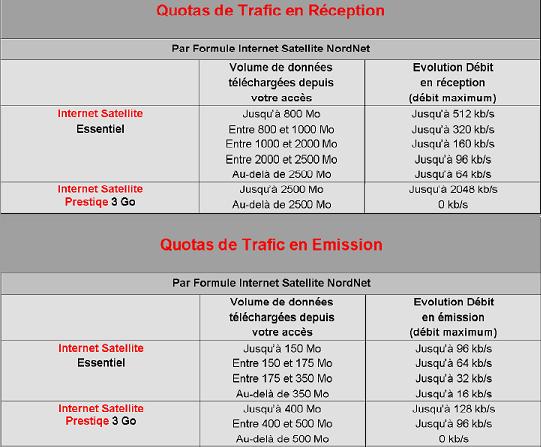 Note that basic service has gradually reducing "up-to" bit rates as you exceed progressively larger Mbyte thresholds. The headline "3 Gbyte" service, offers 2.5 Gbyte download and 500Mbyte upload, with the service interrupted to zero once you exceed your monthly quota. The volume of data exchanged is reset once a month. I support the idea that customers should be able to monitor their upload/download amounts in real time as being recorded at teleport hub. Ask about this. Anyone trying to sell satellite internet access service should have a web site that works well with dial-up data speeds... Best regards, Eric. |
|
Dec 23rd, 2009 at 5:30pm
I find your comment Eric of the average speed misleading. This figure is meaningless as no one downloads 24/7. I run a 2048 kb/s download and tests show that this speed is often achieved. There is obviously the normal latency before the downloads start. NordNet supply a daily usage graph which you can check against your figures. I have found them fairly close. I also do not see my original post as misleading or Spam advertising. I was just letting people know what NordNet were now selling and who could supply it. Then as any good forum it needs discussing and elaborating on. By the number of reads of the thread it shows that people were genuinely interested in what is available in France. You were very right about the size of their documentation for downloading. At least you can ask for an information pack to be sent by post!! How did you get on Carl? Merry Christmas |
|
Email me:eric@satsig.net |