|
|

| SatSig Topics Index › Dish pointing and alignment › Re: Dish, LNB, DVR/STB, Signal Mtr, Compass etc |
SatSig topic: Re: Dish, LNB, DVR/STB, Signal Mtr, Compass etc(Read 1408 times) |
|
Apr 30th, 2011 at 5:17pm
//greg// |
|
May 14th, 2011 at 11:07am
As I said earlier, I am new to this Satellite / Transponders / Dish / LNB subject. So, I wish that I could get some little more detailed replies from members, who are experts in this field. Thanks in Advance (TIA). *********** I wish to expand my queries on the specific Points : (2), (3) and (4) of my above Msg 1. I will post each of these in separate postings following this one. TIA to whoever is helping me with replies. ... |
|
May 14th, 2011 at 11:13am
This Msg Sub-Title : Specs of (Full) HD-DVR and (Full) HD-STB, spl for FTA Channels The Specs that I am looking for in a HD-DVR / HD-STB are given below. Kindly let me know the Model & Brand Names of Top 2 or 3 HD-DVRs and Top 2 or 3 HD-STBs that come closest to these Specs in worldwide markets like US / UK / Singapore, and in India : 1) FTA Receivers FTA HD-DVR as well as FTA HD-STB - to receive High Density (HD in fact, Full HD, 3D) signals : - Full HD 3D Compatible - 1080i / 720p / 576p / 576i Video Formats - Fully DVB-S & DVB-S2 (HD, Mpeg-2 / Mpeg-4 ?) Compliant ; also compatible with H.264 - Auto Satellite Program Function with Scanning Option - Predefined Program (Forced Tuning) with AGC / BER Signal Bar - What is the facility to upload the FTA File ? {Is it through USB Port, or through any Card type device ?} - 2 or more Smart Card / PCMCIA Card Slots are these slots for adding CAM Modules for decrypting additional Encryption Codes ? - Variable Input Symbol Rate 2-45 MSPS, or better - USALS DiSEqC 1.3 Compatible with supply of 12 to 24 Volts DC to rotate the Motor clockwise and anticlockwise ; I was told that a further 2 wires are connected to a Reed Relay that operates for each turn of the motor. So, we need a compatible Receiver / Antenna Controller that supplies the DC Power, and also counts the pulses. - LNB Controlling Logic 13 / 19V, 0 / 22 KHz Tone - 2 USB Ports any one of them can be used to upgrade the S/W ? - 2 HDMI Outputs ? - Component Video : Y, Pb & Pr Outputs - RGB Outputs through SCART - Digital Audio Output (Optical ?) *********** 2) Plus the foll specs for Full HD-DVR : - > 1 TB Storage, better still, if stated in terms of Highest Quality Full HD Resolution Recording Time (instead of mere TB / GB) - Facility to simultaneously view One Channel and Record another Channels Pgm for later viewing - More than 1 Profile (a Profile for each Fly Member sort of ones own Fav Channels) - Buffer Capacity in terms of Full HD Viewing time - Will this also play Blu Ray DVDs ? - Compatibility with Full HD-3D *********** 3) Plus features for Satellite Internet (if the same Box can be used for Sat Internet also ? (Yes, we need to add the BUC for Uplink, and OMT etc along with the LNB) : [Even if the TV Channels are for free viewing in the FTA Receiver, we still need to go through some ISP for Sat Internet Bills. How is that achieved ?] For eg, Zuku (https://www.lyngsat.com/nss12.html (57 Deg E, East Africa Beam)) is a 3-in-1 Service Package, that brings, TV, Internet and Phone services in a single access subscription. - Would like to have more Details of built-in Sat Internet in the same DVR / STB Device ?? *********** Thanks in advance (TIA) for yr replies. ... |
|
May 14th, 2011 at 11:27am
This Msg Sub-Title : Top Quattro LNB Models / Brands ; Control Cmd to each LNB of Quattro LNB 4-a) I would like to know the Top 3 4 Brands of Quattro Universal LNB with very low Noise Temp Ratings (less than or equal to 17 Deg K) in worldwide markets like US / UK / Singapore, and in India, and their costs. 4-b) Is it possible to control EACH LNB in the Quattro Universal LNBs' Set (ie, ability to change the Pol, as well as change the Band of EACH LNB) from a single HD-DVR or HD-STB Box ? ie, a scenario, in which all 4 LNB outputs are connected to a single HD-DVR or HD-STB Box. You can consider the worlds best available HD-DVR or HD-STB Box for this. If this is possible, then, one can view one Channel in say Tp1-KuHigh-H Pol, and also simultaneously record 3 other Channels Pgm (from say, Tp2-KuLow-VPol, Tp3-KuHigh-Hpol, Tp4-KuLow -VPol) etc. Do you agree ? I assume that the Azimuth Angle can be changed to match with that of the Transponders, if we have Motorised Dish with USALS DiSEqC 1.3 Compatible Inline Coaxial Cables. But is there any provision to change the Elevation of the Dish also, as we move from one Satellite to another ? I would like to know the Specs, Make, Cost etc of such a FullHD-3D-DVR and FullHD-3D -STB Boxes. Thanks in advance (TIA) for yr replies. ... |
|
May 14th, 2011 at 11:34am
I would like to know the List of Testing Instruments that are normally required for a perfect tuning eg, Signal Strength Meter, any Spectrum Analyzer also ?. It would be great if the Meter also has a built-in Magnetic Compass ; still better would be if it has a built-in GPS Receiver also ?? ; plus any aid for Perfect tuning of Polarisation and Azimuth Angle measurement etc ? Kindly let me know the Model & Brand Names of Top 2 or 3 such Instrument(s). Thanks in advance (TIA) for yr replies. ... |
|
May 14th, 2011 at 12:44pm
Normal requirements are a satellite TV type meter and the ability to use the VSAT modem and PC interface to read out the signal quality of the VSAT outlink carrier. Satellite TV type meters vary from the very basic noise power meter to ones incorporating a spectrum analyser capability. All you really need is a simple noise power meter plus the VSAT modem, or even the VSAT modem only, plus laptop PC at the antenna. It is nice to have a satellite TV meter which has the ability to recognise a known TV carrier on a particular satellite and thus say "satellite found" - but only if you understand the limitations and know how to use it. It works best if you have done it recently before and know that the TV carrier still exists, is on the same polarisation and the L band pre-tuned frequency in the meter matches your LNB local oscillator frequency. Initial polarisation alignment is best done by calculation and using an inclinometer sideways across the BUC, with final adjustment done under verbal instruction from the hub NOC. Local optimisation of polarisation needs a decent spectrum analyser and significant skill, similar to peaking up by finding the two steep sides of the cross-pol null and then putting the polarisation angle mechanically to the center. You need +/- 1 deg rotational accuracy. When choosing a meter with a "satellite TV carrier recognition facility" make sure that it is manually programmable by you (L band tuning and symbol rate) and does not only work with secret codes from the manufacturer. You must be able to verify yourself the calculation: L band frequency equals actual satellite downlink carrier frequency minus LNB LO freq. Only you know the LNB LO frequency that you are using. The manufacturer of the meter does not. Look here for typical meters: https://www.sadoun.com/product-category/satellite-tv-products/satellite-dish-sys... Best regards, Eric. |
|
May 18th, 2011 at 4:37pm
Let us assume a USALS controlled Sat Dish Motor and Quattro Universal LNB. I assume that we can have the foll config : (Pl confirm that this Config Combination is achievable.) : 1st LNB of Quattro Univ LNB : to Ku-High Band, Hor Pol, connected to DVR / STB 1 -> TV 1 2nd LNB of Quattro Univ LNB : to Ku-High Band, Vert Pol, connected to DVR / STB 2 -> TV 2 3rd LNB of Quattro Univ LNB : to Ku-Low Band, Hor Pol, connected to DVR / STB 3 -> TV 3 4th LNB of Quattro Univ LNB : to Ku-Low Band, Vert Pol, connected to DVR / STB 4 -> TV 4 Pl see the Sketch : Mtr-Dsh_Qtr-LNB_4-STB-TV_Fig-3.jpg 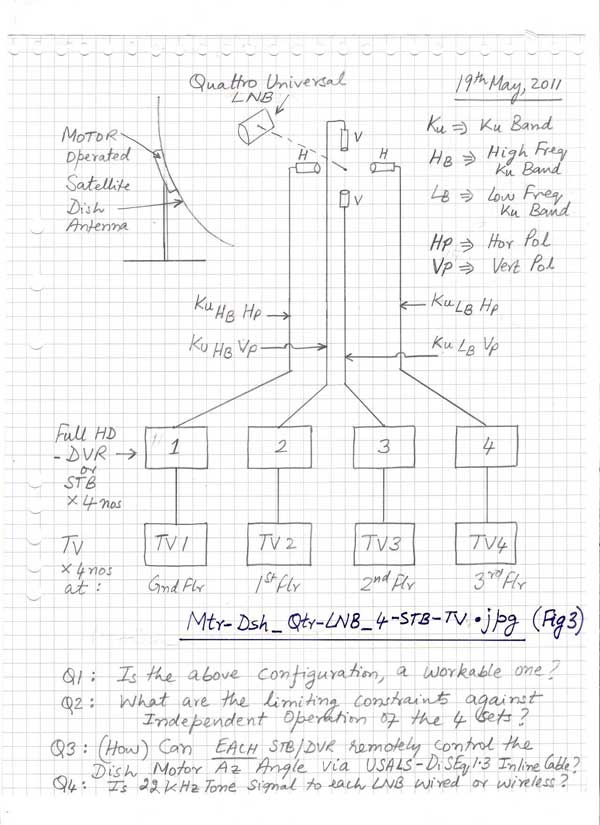 *********** Q1 : Is the above Configuration, a workable one ? The aim is to SIMULTANEOUSLY watch 4 different TV Channels in the 4 TVs. Q2 : What are the limiting constraints against Independent Operation of the 4 Sets ? We would like to have INDEPENDENT control over Ku Band High / Low Selection, as well as V / H Pol of EACH LNB with Control Commands from its respective DVR / STB. Q3 : Since we have only one Dish and only one Motor attached to the single Dish : (How) Can EACH DVR / STB remotely control the Dish Motors Azimuth Angle (and Elevation Angle also possible ?), via USALS DiSEq1.3 Inline Cable Command ? How can we have 4 independent Inline Commands, all operating on the same motor ? Even if we were to accept a clash of commands, will such a paralleling of 4 connections at the Dish Motor Point, be electrically correct ? Q4 : How is the 22 KHz Tone Signal actually transmitted to the LNB to switch from Low to High Band, or vice versa ? Is this 22 KHz Tone signal, a wired command, or a wireless command ? If it is a wired command, which 2 points does this wire (pair of wires ?) connect ? *********** Would appreciate if you could quote the Query / Point No in yr replies. Also, it is preferable to state the Sketch File Name in yr answers, since I have loaded 4 different sketches giving various Configurations. Thanks in Advance (TIA) PS : The "Image Tag" does not seem to work with sendspace urls, probably because sendsapce does not provide a *.jpg extn ?? Hence, you may have to download the above image from the sendspace link provided. ... |
|
May 18th, 2011 at 4:43pm
1) I would like to know if DVRs / STBs are available with 2 Outputs to connect simultaneously to 2 TVs ie, are 2 HDMI Output ports available ? Alternatively, can one Output of the Box be a HDMI Port, and another a Coax Cable Port ? Pl see the LEFT Side Sketch of : Sngl-STB_Sngl-LNB_For-2-TVs_Fig-4.jpg 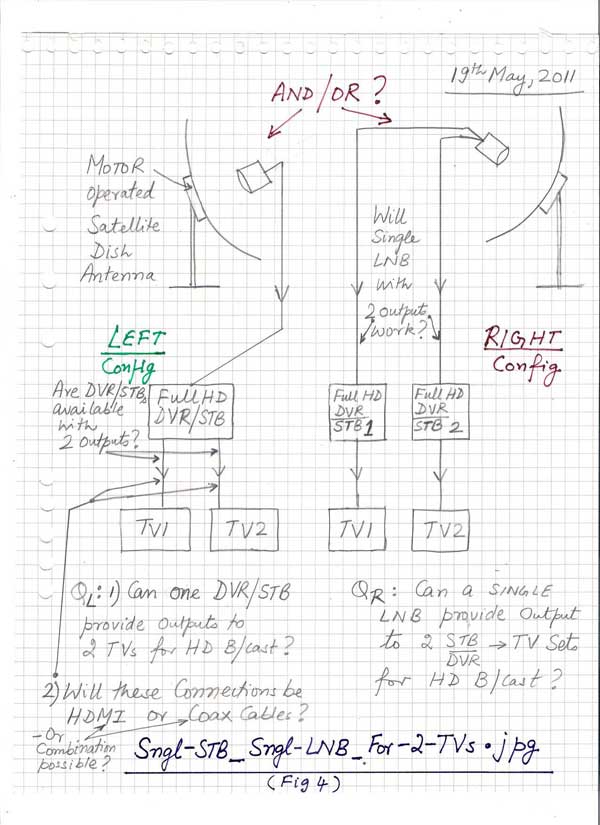 What will the dB Loss be on account of paralleling 2 outputs from the same DVR / STB ? ************* 2) On the RIGHT side of the above Sketch, is a config showing 2 output connections from a single LNB, to drive DVR / STB 1 -> TV 1 and DVR / STB 2 -> TV 2. What will the dB Loss be on account of paralleling 2 outputs from the same LNB ? ************* Thanks in Advance (TIA) Would appreciate if you could quote the Post # No, Query / Point No in yr replies. Also, it is preferable to state the Sketch File Name in yr answers, since I have loaded 4 different sketches giving various Configurations. ... |
|
May 18th, 2011 at 4:55pm
Mtr-Dsh_Sat-TV_Sat-BB_Cbl-TV_Fig-1.jpg [This is an Overall Configuration Proposal Sketch, combining BUC for Sat Internet, as well as Cable TV, Router etc.] 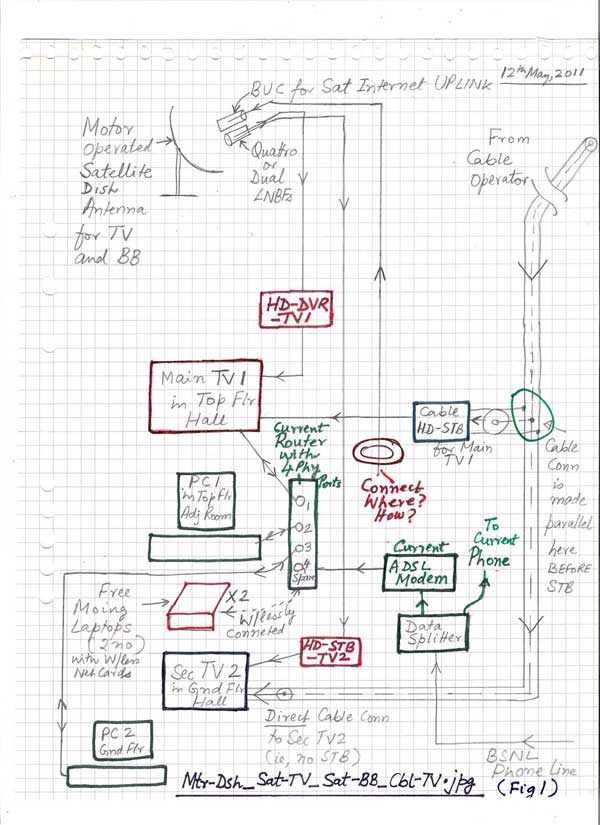 The query here is marked in Red Concentric Ovals : How / Where do we connect the other end of the BUC Wire in this setup ?] |
|
May 18th, 2011 at 5:56pm
The two coax cables connect to an indoor satellite internet modem. Your side of the satellite internet modem is a single ethernet socket with LAN capability - multiple PCs may be connected, normally via a router/wireless/4port device. Best regards, Eric. |
|
May 18th, 2011 at 6:46pm
The Quattro LNB does produce 4 permanent outputs (Vert Hi, Vert Lo, Horiz Hi, Horiz Lo) each different. It is suitable only for a block of flats or anywhere with more than 5 satellite TV set top boxes. An additional device (e.g. TRIAX multiswitch https://vektorguvenlik.com/pdf/triax.pdf) is needed between the 4 cables from the LNB and the 5 or more single cables to the TV set top boxes. If you have 4 or less satellite TV set top boxes you need a Quad LNB. In this case each of the four cables has the full choice of Vert Hi, Vert Lo, Horiz Hi or Horiz Lo, using 22kHz tone and voltage control from each set top box. That is what you want. Regarding motor control on a polar mount, there is one motor that drives the antenna about the polar axis. The dish aims in a line across the sky, intended to be able to see all visible satellites, one at a time. As the antenna rotates about the polar axis the beam azimuth, elevation and polarisation alter simultaneously. Best regards, Eric. |
|
May 19th, 2011 at 10:45am
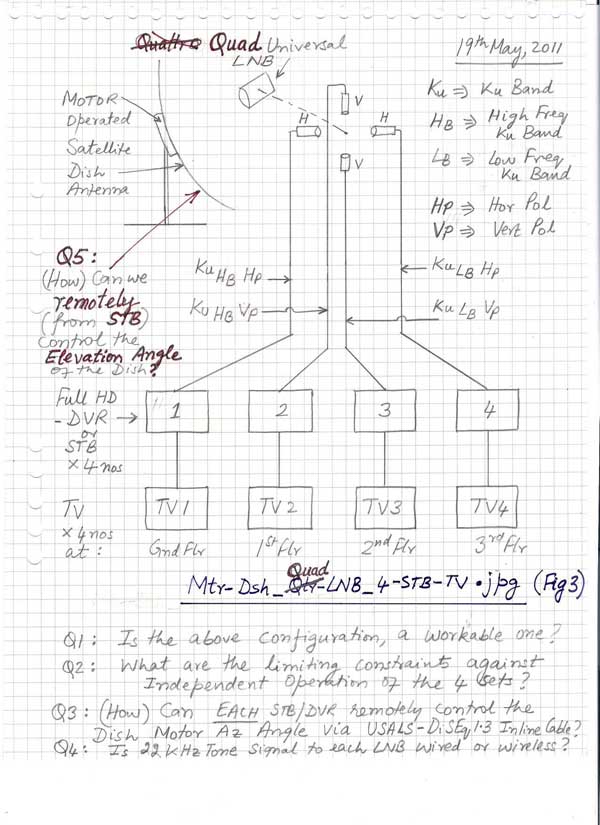
Thanks for properly placing the 4 images, where they are apt, in my Posts. Thanks for your reply on Quad vs Quattro LNBs. First, I would like you confirm if these are typo-errors in your Reply # 11 to my Post # 7 : >> The Quattro LNB does (missed the NOT here ?) do what your diagram suggests. Your figure showed four wires connected to 4 dipole probes into the circular waveguide. Two wires would each pick up half of vertical polarisation signal power and two wires would each pick up pick up half of horizontal polarisation signal power. To make it work properly you need to merge the 2 vertical polarisation wires into one and then into a broadband LNA. Similarly the horizontal polarisation inputs. Having got two broadband signals (vertical and horizontal) you then need switching and four block downconverters (each with local oscillator and mixer and L band IF amplifier) to feed the four output cables. >> anywhere with more than 5 (or you meant 4 ?) Satellite TV STBs. I meant 5 or more. *********** The word Permanent in your Reply, was the key clue to my understanding of the diff between Quattro vs Quad. So, in effect, the word Universal, meaning the ability to change the Band as well as Pol, is NOT applicable to Quattro LNB, since all 4 LNBs are permanently fixed with respect to Band & Pol. Appreciate your specific confirmation of this. Also, as a default, are all Quad LNBs available in the Market, essentially also always Quad UNIVERSAL LNBs ? Your view that each LNB of the Quattro, is on a diff Band, and diff Pol, is also expressed: A Quattro LNB has 4 outputs, EACH of them supplies only 1/4 of the available channels (Lo/Hi band and H/V polarization). But he could have done better by using permanently also. In this context, it then seems to me that the explanation given in https://www.tech-faq.com/lnb.html is probably somewhat misleading, since it was because of this definition that until now, I thought that the Quattro can achieve total independence of all 4 LNBs, which in fact now I know, is achievable, in the Quad, not the Quattro. *********** Fine, I need Quad (not Quattro). But, other than this change, I would like to know, what else is not correct in the image (Fig 3), since you have said : >> The internal arrangement depicted in the image is NOT correct, but the functionality and labels are correct. *********** In Post # 4 dated 14th May, 2011, I had raised the following sub-queries under (4-b) : The 2nd part of (4-b), re-worded now : With Motorised Dish, we can change the Azimuth Angle by Remote Commands from the STB. Fine. But, what about changing the Elevation Angle if we wish to change focus from one Satellite to another, whose Elevation Angle requirement may be drastically different ? The 1st part of (4-b) : We know that by using a QUAD Univ LNB, we can connect to 4 diff STBs. But, is there any Top Brand STB (or DVR) which can accept ALL these 4 Inputs from the 4 LNBs of the Quad ? If this is possible, one can go on experimenting as a hobby, by connecting the SAME STB / DVR to diff LNBs, each LNB / Transponder, having its own list of FTA Channels. Plus, with Motorised Dish, we can also focus on diff Sats ! all remotely from the STB / DVR. Only query still is : how do we change the Dish Elevation also Remotely from the STB / DVR ? *********** They have not mentioned the Noise Temp Rating like say, less than 17 Deg K. If you have info about it, could you please let me know. 0.31 dB does it give any indication of the Noise Temp Rating ? Elsewhere, I have seen LNBs with 0.1 nf, 0.3 nf, 0.5 nf, 0.7 nf and 0.8 nf. Pl confirm that nf implies Nano-Farad Capacitance Value. If yes, at what location in the LNB's Circuit (like in a High Pass Filter Ckt, or as a Blocking Capacitor etc), is this Nano-Farad Capacitance mounted ? Is it better to have a higher value, or a lower value, for this nf component ? Which will give better gain ? *********** Please also see my latest Post with Fig 5, that I intend to post shortly in : https://www.satsig.net/topics/satsig-topic-num=1305730001 *********** TIA ... |
|
May 19th, 2011 at 11:49am
 |
|
May 20th, 2011 at 10:35am
They have not mentioned the Noise Temp Rating like say, less than 17 Deg K. If you have info about it, could you pl let me know. 0.31 dB does it give any indication of the Noise Temp Rating ? Elsewhere, I have seen LNBs with 0.1 nf, 0.3 nf, 0.5 nf, 0.7 nf and 0.8 nf. Pl confirm that nf implies Nano-Farad Capacitance Value. If yes, at what location in the LNB's Circuit (like in a High Pass Filter Ckt, or as a Blocking Capacitor etc), is this Nano-Farad Capacitance mounted ? Is it better to have a higher value, or a lower value, for this nf component ? Which will give better gain ? In my opinion the noise figures quoted ( 0.1 nf, 0.3 nf, 0.5 nf, 0.7 nf and 0.8 nf. ) are mostly marketing hype. Ignore them. Lower figures mean the device is supposedly less noisy, i.e. better. By nf they probably are referring to noise figure or noise factor. The correct abbreviation for nano-farad is nF, and they definitely don't mean that. Noise figure, noise factor or noise temperature makes no difference to the gain, which is typically about 50 to 60 dB for a domestic LNB. Read more here: https://www.satsig.net/noise.htm What matters is the total receive system noise temperature, so the noise temperature of the antenna, mainly due to sidelobe pick up from the warm ground is important. During rain, the noise temperature goes up due to the warm rain so if you are concerned to minimise rain fade outages, more gain from the dish (larger diameter) is a better investment than lower noise temperature in the LNB. Quote: Plus, with Motorised Dish, we can also focus on diff Sats ! all remotely from the STB / DVR. Only query still is : how do we change the Dish Elevation also Remotely from the STB / DVR ? The polar axis motor turns the dish along the line of the orbit, so you may point the beam at each satellite, one at a time. The azimuth, elevation and polarisation angles all change simultaneously. There is no extra motor for elevation. You may have read about an additional motor for inclination angle. This is rare and would only be used to track an inclined orbit satellite. The inclination movement would be north-south, at right angles to the east-west orbit line. Best regards, Eric. |
|
Email me:eric@satsig.net |