|
May 10th, 2011 at 4:51pm
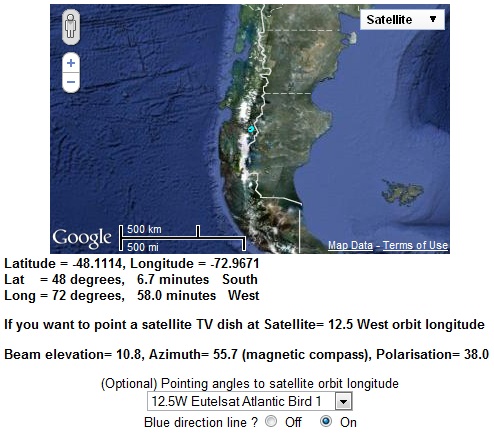
It makes sense to tilt the front face of the dish 12.5 deg forwards in order to get a beam elevation of 10 deg.
(22.5 - 12.5 = 10 )
If you have an inclinometer place it on a plank of wood and hold it at a 10 deg slope. Get someone to look along the wood. If they can see clear sky above the mountains then your dish can see the satellite.
At a beam elevation angle of 10 deg you may find that the bottom rear metalwork of the dish spine almost hits the pole.
If you get a signal level of 22 and the elevation angle seems right you have probably found the wanted satellite. Peak up.
22 is a reasonable, but not brillant signal. The scale range is 0 to 29. The maximum for the signal power range is 29
The reason the 22 won't make the modem RX LED come on and the reading jump up to some signal quality reading like 80 with RX LED ON, is that one or more of the following are still wrong:
Polarisation initial setting and polarisation adjustment amount: You need to start with the LNB pointing either directly upwards or sideways (the two different polarisation names). From either of these starting positions you need to turn the feed 37 deg clockwise as viewed from behind the dish and facing forwards towards the satellite in the sky (to the north east). You can quickly try both polarisation names by turning the feed 90 deg between the two alternative +37 adjusted positions. One position will work perectly, the other not at all. You may get good power readings at all angles.
Configuration settings: Frequency, symbol rate, 22kHz tone ON/OFF and LNB menu type are important. If there are errors then the modem receiver won't lock, even if peaked up on the wanted satellite (level=22).
Can you read out the information from the manual configuration screen?. What is your LNB type and model number ?
Best regards, Eric.
|