|
Mar 27th, 2013 at 10:08am
All earth stations in the Tooway system must comply with the KA-SAT Tooway inter-system coordination agreements with regards to off-axis sidelobes and cross-pol isolation. In addition, Tooway impose their own rules on transmit gain and receive G/T. The objective is to avoid unacceptable interference to or from other satellite users, at the same frequencies.
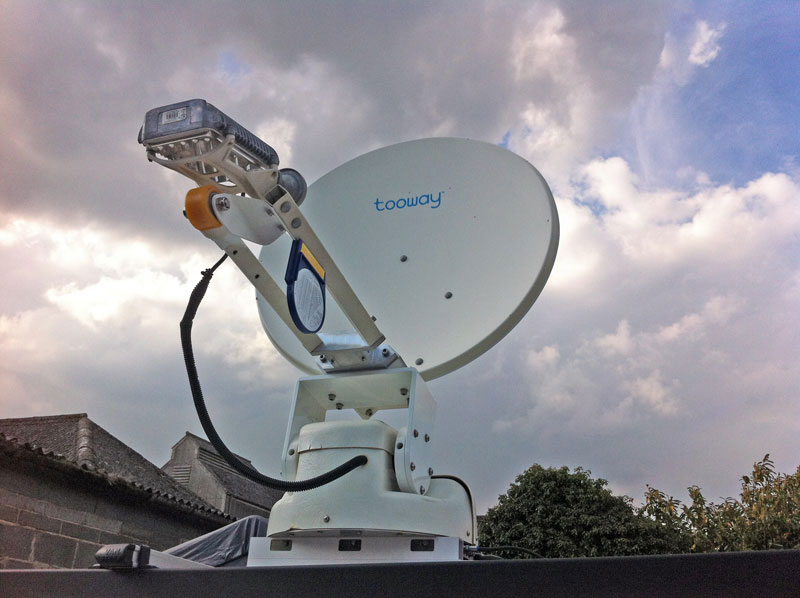
The only realistic and legal way you can meet the requirements is to use the standard Tooway reflector, feed support arm and feed/RF module.
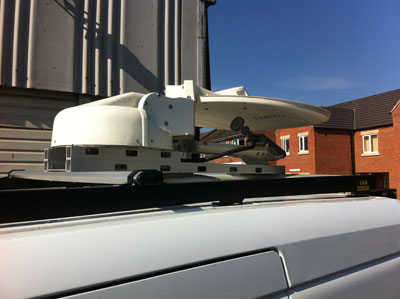
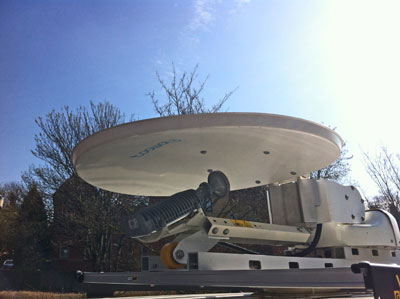
I doubt there would be any objection to using a steerable mount, with an attached complete Tooway antenna and RF module. Just make sure it is stable and does not wave about in the wind !
Note the following:
Antenna surface accuracy needs to be better than 1/10th wavelength. At 30 GHz the wavelength is 10mm, so surface accuracy must be 1mm or better. This is very difficult to achieve and dishes must be transported and handled very gently indeed. Wire mesh dishes are fine for low frequencies like L band. For C band and Ku band, a fine wire mesh can be acceptable. At Ku band perforated metal sheet is OK. For Ka band, a solid continuous metallic surface layer is needed.
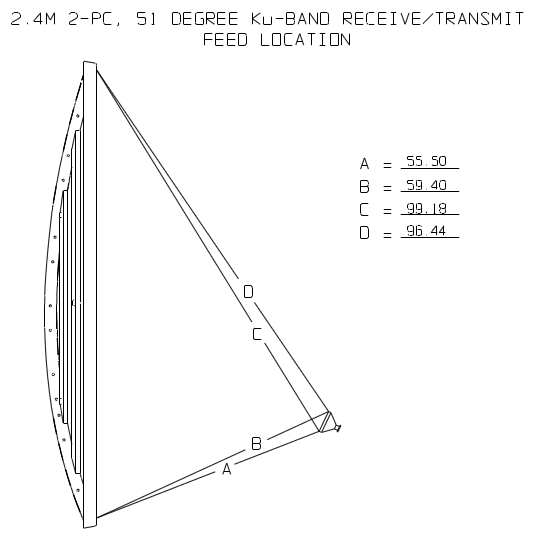
Feed horns distribute their power across the dish surface, with power density being higher in the middle and lower at the dish edge. Typically the edge taper will be around -16 dB relative to the dish centre. This is key to low off-axis sidelobes and pick up of minimal thermal noise from the ground. If the F/D ratio of the dish is small the feed horn is close to the dish and must spread its energy wide. Such feeds typically comprise an open circular waveguide with, possibly adjustable, scalar rings.
If the F/D is higher the feed is further away from the dish and the feed must project its power into a smaler angle. Such feeds are normally conical horns and have a larger aperture diameter.
For VSAT use, the feed horn and the reflector dish are highly interrelated and should not be swapped about.
Best regards, Eric
|