|
|

| SatSig Topics Index › Satellite Internet - Europe › Ka-band signal rain fade ses broadband beyondsl |
SatSig topic: Ka-band signal rain fade ses broadband beyondsl(Read 27538 times) |
|
Oct 3rd, 2013 at 1:06am
|
|
Oct 3rd, 2013 at 11:13am
Ka band does suffer much more severely from rain compared with C band (negligible effect) and Ku band (moderate effect). This is an example report: https://spacejournal.ohio.edu/issue2/pdf/paper_asoka2.pdf 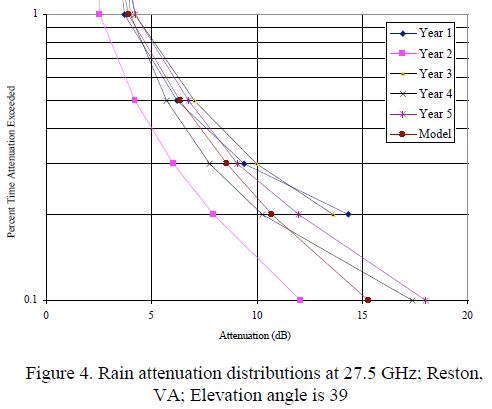 A sample graph taken from this report shows that (excluding one particularly dry year, the pink line, year 2), that if you had a 4 dB margin then you would get a good service for 99% of time and failure for 1% of the time (87 hours per year). If you get yourself a dish with twice the area (1.4 times the diameter) you will improve your margin by 3 dB. But you must have a dish with a surface accuracy approx 1mm, for use at 20/30 GHz. All this sounds bad for 20/30 GHz operation, but be reassured that big efforts have been made to make the attenuation more acceptable. These include reducing the bit rate during rain and changing the forward error correction coding. This involves involves changing the modulation from say 8PSK to QPSK and reducing the bit rate by half during heaviest rain. While the bit rate is reduced, internet type data transmission continues, but perhaps temporarily congested, as packet errors remain negligible. Customer VSAT equipment, such as Tooway, uses a BUC (transmit amplifier) which is normally operated well below its maximum output power. During rain the uplink power is automatically increased. Do make sure your dish is pointed perfectly in clear sky, you can easily "use up" your intended margin by poor pointing, in which case your service will have minimal margin, and fail in the slightest rain. It really does matter that you centre the beam perfectly as the transmit beam is narrower than the receive beam. Half the angle between equally degraded levels either side of the beam peak for best results. It is no good to think in terms of getting a receive signal that is good enough, as this is an ill defined, far too broad region around the receive beam peak. Note the above is bit of a simplification: Rain also causes cross-pol interference to increase and degrades the link also due to the thermal noise emitted by the 'warm' rain (290 deg K). Compare with typical 120K of Ka band LNB, plus 100K for the antenna, in clear sky. The large teleport hub station has its uplink power control problems also! |
|
Oct 3rd, 2013 at 7:54pm
One thing I am confused with is the skew of the dish for Astra 2f at 28.2 my reseller tells me the skew should be 22.4 for my location but I know that the skew for all the Astra satellites at 28.2e east is not that high for ku band as in the uk the LNB-F on the Ku-band dishes sky uk use can not be skewed that much so the satellites at 28.2 have different skew to the other satellites on the arc. I've seen an example where it says the lnb skew angle the skew for eurobird 28.5 east vs astra 28.2 is 7 degrees different or see post 2 here https://forums.digitalspy.co.uk/showthread.php?t=1132108 Also more proof of this is if you go to dishpointer.com and put in your location and look at the skew for Astra 28.2 east and then look at Eutelsat Eurobird 28.5 east you can see that 28.2 east has non standard skew this is due to not being able to sky the whole of the elliptical sky mesh mini dishes you can only sky the lnb on it and if you over skew the lnb on the the feedhorn does not match the shape of the dish, But on my solid dish Gilat ka-band system you can skew the whole dish and it has marking on the dish admin here is a video of the set up I have https://www.youtube.com/watch?v=xohFf4-KyME So admin do you know does the KA band at 28.2 east have non standard skew like ku band? Many thanks |
|
Oct 4th, 2013 at 5:00pm
In contrast, I believe that Eurobird Ku band polarisation is normal. i.e. vertical is parallel to the earth axis and horizontal is parallel with the equator. That explains why, as seen from London, 28.2 deg Astra is -20.7 deg polarisation adjustment and Eurobird -13.7 deg polarisation adjustment. Note ( - ) minus means anticlockwise as viewed looking towards the satellite in the sky. SES documents say that the three Ka band transponders on Astra 2F use circular polarisation. No LNB rotational adjustment angle is therefore required; simply select the wanted polarisation using voltage 13/19V or, if applicable, by mechanically setting the polariser at the alternate +/-45 deg position. Some Eutelsat satellites (linear polarisation at Ku band) have a +3.5 deg clockwise misalignment. The reason for these misalignments is from the early days of the OTS (Europe) satellites (1980's), when it was decided that there was benefit in having the polarisations in the coverage approximately parallel and at right angles to the ground to minimise raindrop depolarisation effects when the rain is falling vertically and the underside of the drops horizontal. Given that beams now cover far more of European periphery, actual polarisation adjustments are often large and the 'benefit' is minimal for many customers and the nuisance a continuing problem for all installers! Best regards, Eric. |
|
Oct 4th, 2013 at 5:34pm
Regarding this video about the installation of the solid dish Gilat Ka-band system. It shows that you can skew the whole dish using a giant circular scale on the back, similar to the Prodelin VSAT design. This polarisation rotation plate is tilted such that the beam remains pointed at the satellite whatever angle you set. THIS ADJUSTMENT IS ONLY APPLIABLE TO LINEAR POLARISATION. When operated with circular polarisation it will make no difference at all. The only benefit might be if you have a problem with a very high elevation angle required at your location causing rain/snow to accumulate on the dish. In these case rotate the whole assembly to avoid a puddle in the dish or accumulated snow. 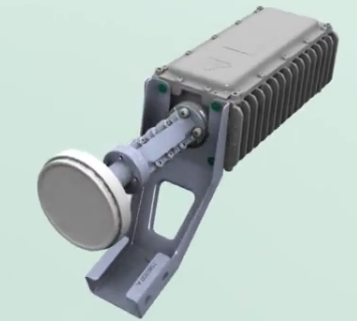 This still image from the video clearly shows the Ka band transmit/receive module, polariser and feed. The tx/rx module produces linear polarisation. Attached is a polariser which is tilted 45 deg to the linear polarisation aperture in the tx/rx module. At the junction between the polariser and the feed, the tx and rx polarisations are circular. Which way is RHCP or LHCP depends on the way the polariser is bolted to the tx/rx module. 45 deg either way. Alternatively if the tx/rx module has internal switchable linear polarisation, then polarisation switching within the module may be possible, and using an external polariser at a permanent 45 deg angle it is possible for the indoor modem to change polarisations by remote control. Tooway has this capability with a switch rated for several hundred operations. Best regards, Eric |
|
Oct 4th, 2013 at 9:46pm
here is some more vids Modem gilat aeries https://www.youtube.com/watch?v=mEcG1WI9ILg Feed horn lnb buc transmitter unit https://www.youtube.com/watch?v=EDvW_gtuxmA And installers guide https://www.satelliteinternet.co.uk/images/pdf/gilat/121128_DIY_CPE_Installation... |
|
Oct 4th, 2013 at 10:29pm
The skew-plate is for use when the system is operating linear polarisation. if you want to learn more, read how to set up circular polarisation at C band. This explanation refers to a 4/6 GHz system where the 4 GHz and 6 GHz are combined in an OMT and the only way the polarisation can be changed is by unbolting the polariser from the OMT and reattaching the other way. Ideally at Ka band the linear polarisations inside the tx/rx module are switchable internally (electronic or electro-mechanical - controlled by the indoor modem) and with no physical bolting change is required. |
|
Oct 14th, 2013 at 1:50pm
Best advice I can give you with the skew is to set it to what's recommended then adjust the skew while monitoring the signal strength on your laptop. I find that will peak your reading to the best available. Hope this helps you, regards Kevin - OrmeSat |
|
Oct 14th, 2013 at 8:32pm
I sorted the skew out as Eric has said the skew does not matter as it is circular polarization I should have remember this for my c-band days, I peaked the dish with my spectrum analyzer but as i write this the the cloud cover has passed and I can now see the stars in the sky but Have 4.9DB of signal and if we now have a very very light shower I will lose a few DB of signal and then if we have normal rain the signal is gone, I do agree with you wf100 or wf125 would help allot I will do a test tomorrow as I have a few short 5m lengths of wf100 here so I will test tomorrow I also think that a nice solid 1.2m or 1.5m solid dish would help lot too but most people would not have this on their home, So to me the dish is not big enough to allow for rain fade Quote: I've had the same problem with my first couple of SES installs where the signal drops from 6.8 to less than 4 in rain, this caused lots of problems with my first few installs. Have now realised what the problem is: it comes with 30 metres of cable which is useless in bad weather unless you're smack in the centre of the footprint. I resolved it by installing CT100 or Webro100 copper cable, now the systems are working fine (with readings above 7.5). It's like when the Tooway system started a couple of years ago we were told initially it would work with RG6 cable, happy days we thought: it's a lot cheaper than the copper CT100. Within a few days we were getting called out as customers were unable to get online. Again the issue was that you CANNOT use the cheaper cable so we had to change the cable which sorted the problem.
Best advice I can give you with the skew is to set it to what's recommended then adjust the skew while monitoring the signal strength on your laptop. I find that will peak your reading to the best available. Hope this helps you, regards Kevin - OrmeSat |
|
Oct 14th, 2013 at 9:13pm
and here https://www.satelliteinternet.co.uk/component/content/article/17-pages/37-servic... |
|
Oct 15th, 2013 at 10:58am
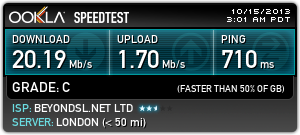 using.. https://www.speedtest.bbmax.co.uk/ But when we the clouds do go past the signal will drop to around 4.5db then also the ping times will increase to 3x that of the tooway system making web browsing painfully slow then when it rains signal is gone, |
|
Oct 15th, 2013 at 6:51pm
At 30GHz dish shape critical. Avoid any distortion. Tx beam narrower than Rx beam so centring difficult. Eric |
|
Oct 16th, 2013 at 4:44pm
A ticket has now been raised with the ISP SES Astra but I think it will not resolve any think I think the dish is too small to allow for bad weather |
|
Oct 18th, 2013 at 1:21pm
|
|
Oct 18th, 2013 at 3:05pm
Check that you really have a circular polarisation system. If you have linear, and there happens to be no carrier on the opposite polarisation then your Rx and tx will both be 3 dB low. Ask your service provider what Rx s/n is expected for your dish size at your location. Gently push both sides of the dish forwards/backwards, both the same way. Does this help? Even 2mm dish distortion will make at lot of difference. There are often distortion problems when the feed support arm is attached to the dish rather than the backing structure. The dish itself must not be strained and thus distorted. Eric |
|
Oct 19th, 2013 at 12:20pm
|
|
Jul 13th, 2014 at 9:05am
The guy said there would otherwise be additional losses on the path to the satellite, because the sat's dish was skewed the same. I did as told, but kept wondering. Now lately I learned about to which extent some feed horns can have dissymetry in their radiation patternd *and* in the E- and H-field distribution. Now, if we consider two things: the Astra2connect Ka band dish is elliptical in the horizontal sense (so not just a 22 degree offset projection of a circle, as on normal offset dishes, where the ellipse's axe is vertically oriented), The horizontally elliptic Astra2Connect dish seems to match/compensate the feed-horn's radiation pattern which is not round but flattened, while the lnb/buc being at a fixed rotration angle to the reflector, so that that can't go wrong. Now, when the whole dish is skewed, we might in change get identical E /H field dissymetry match between the end user side and the sat, but that's really just a vague guess, because after all we get addition polarization rotation due to faraday effects, and that's why we use circular polarization in the first place. So I'm just reproducing what I was told and my thoughts about it. Maybe, maybe, the dish skew will get you a fraction of a dB more, but I agree that the dish is too small, the signal too low for any rain margin, and it gets worse in France near the Spanish border. I appreciate the system's software compensation which makes the data coding adapt to the conditions in a way that the signal fading stays almost invisibe, if it weren't that the Internet response times become very long. For my personal needs I stick to Tooway. |
|
Jul 14th, 2014 at 8:55pm
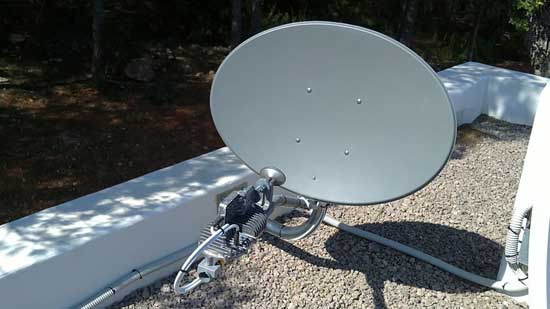 ( reproduced from https://www.satsig.net/topics/satsig-topic-num=1311157952 ) The only reason I can see for rotating the entire dish would be to align the direction of minimum off-axis sidelobes along the geostationary arc so as to minimise interference to and from adjacent satellites. If the antenna is sideways elliptical in outline and has lower edge illumination at the side tips of the ellipse then the side-lobes in the sideways direction will be lower than in the up down direction. Note the feed is elliptical also and will project most of its power at the centre and above and below the middle of the dish. "The wider the aperture, the narrower the beam" If the view of the satellite were to the south east or south west and the line of the orbit sloping then there would be some sense on tilting the ellipse of the dish accordingly. Such action has no effect on the circular polarisation which is set up using the 45 deg polariser. |
|
Email me:eric@satsig.net |