|
Jun 24th, 2014 at 10:00am
Repeating from the first message above: "TAC said that there is trouble on the RF not on the HUB."
Have you actually checked for the presence of 10 MHz at the two TX ports on the hub ? A good starting point in diagnosis would be connect a spectrum analyser (with a DC block and attenuator to protect its input) to each of the TX ports and turn the hub supplied 10 MHz on/off in the software to see if a hub fault really exists.
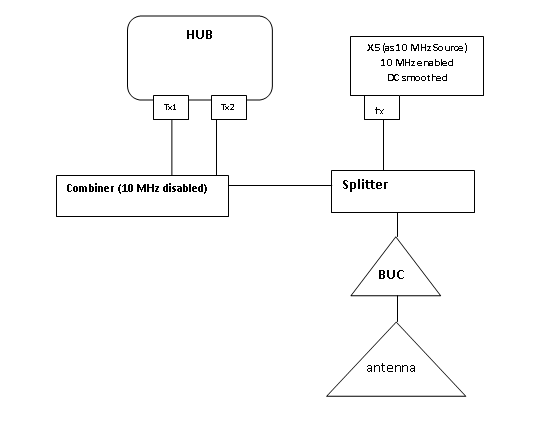
Why do you have a splitter/combiner on the two TX ports ?
Are you transmitting two outlink carriers via one BUC?
If 10 MHz is available from both TX ports, and you need the splitter/combiner, then only one of the 10 MHz should be turned on in the software. If you have both on at once then when they are combined the result may vary from no output at all to twice the level (depending on phasing) and if the two sources come from different master oscillators then the level will vary periodically, as the two frequencies will be slightly different. e.g by one tenth of a Hz.
The splitter/combiner device must be broadband, including from 10 MHz to the upper end of the hub L band output (may be 950-1525 MHz). The splitter/combiner device would need to be ultra-broadband from DC to 1525 MHz if you were using a low power (e.g. 3W) BUC powered via the coax. I'm presuming, in this case, that you have the BUC DC power disabled in the hub.
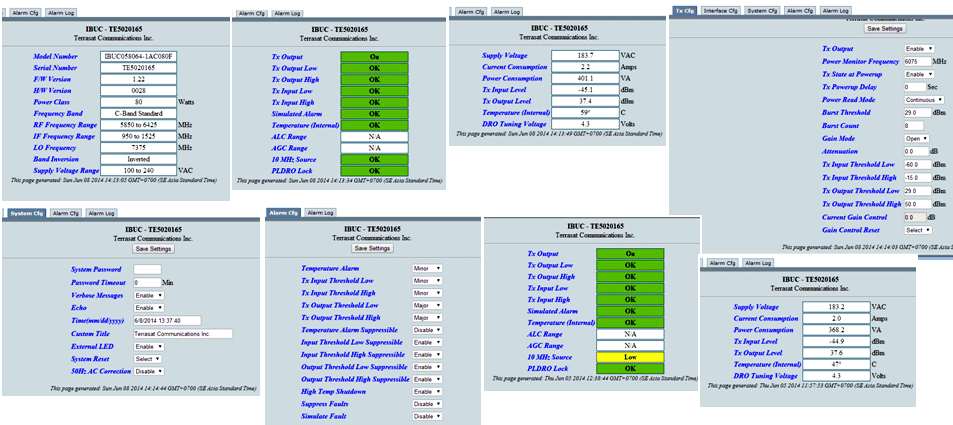
Regarding your iBUC data display. I note that in one instance the 10 MHz input source is shown as low (yellow warning). The BUC upconverter PLL is still locked, so it is still working, but as risk of outage.
|