|
Oct 2nd, 2014 at 8:11am
If the X3 modem output level stays the same, at -27 dBm, when the splitter is inserted, then the burst transmit level will be reduced by about 6 dB and the burst will be too low to be received at the hub. The hub should have measured the burst received level at the hub and told you, and adjusted the level as appropriate.
When an X3 is commissioned, the hub sets a maximum modem output level in the hub database, corresponding to the P-1dB output of the BUC or the maximum allowed EIRP, whichever is the lower. Ask the hub to check all your transmit levels and maybe adjust the maximum value for your modem output. The hub should be watching your transmit TX levels very carefully as there is great risk of you causing intermodulation interference to other services.
When you transmit more then one carrier via a BUC, significant intermodulation products are created if the composite power of the carriers is near to the BUC power rating. If you back off the BUC by say -2 dB, the intermodulation products may be reduced to an acceptable level. -2 dB output back off means that three 5 watt carriers need a 24 watt BUC.
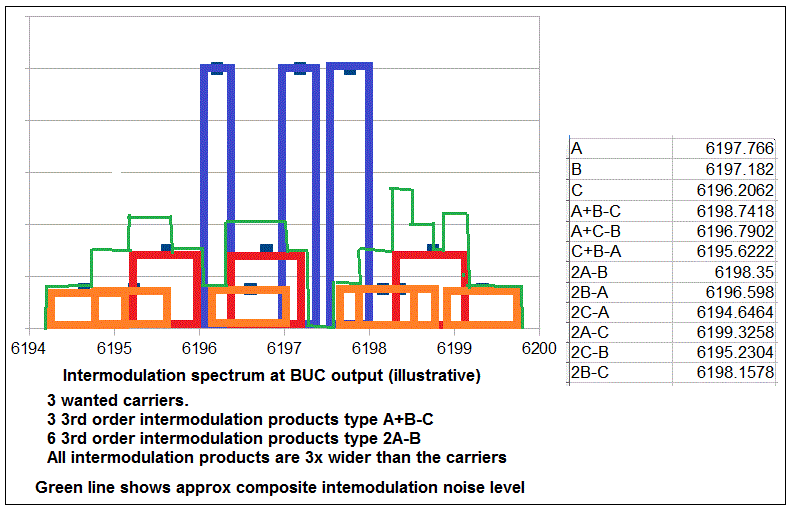
This spectrum drawing illustrates the results of 3 carriers, A, B and C. The red intermodulation products are of type A+B-C.
the orange intermodulation products are type 2A-B. The green line shows the composite intermodulation noise spectrum. Note that the intermodulation interferes with other carriers on nearby frequencies in the transponder.
The sharp cornered rectangles shown are illustrative only. Real digital carriers have rounded corners and the shape of real intermodulation products have very rounded corners and the composite spectrum of the intermodulation is a wide, rounded form, with a number of humps.
Best regards, Eric.
|

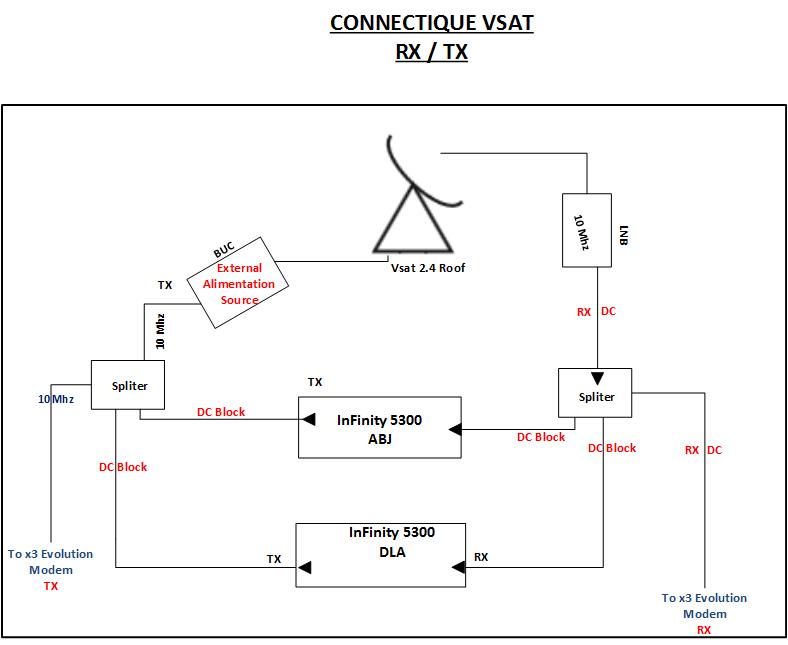

 Don't ask me, why it's working in that configuration. I really don't know. If somebody have an explanation i will be glad to have it.