|
Nov 6th, 2015 at 3:22pm
No, it is not a typo. The site only transmits 45,000 bits in each whole second, even though the transmission rate is 250,000 bits per second.
It is rather like having a 10 Mbit/s or 100 Mbit/s Ethernet port on your computer and you only sending or receiving only 2 Mbit/s. A lot of the time the Ethernet is idle.

In TDMA, other sites will be transmitting when you are inactive,. e.g. you are active for 180 mS, other sites are active during the remaining 820 mS, of each whole second.
In the case of VSAT transmit MIR (minimum information rate), the hub controller guarantees you a minimum of one 180ms burst per second provided you are actually needing it at the time. These figures are an illustrative example only.
In the case shown, Site 1 is doing 45 kbit/s. The burst is repeated in the same place in second TDMA frame, making a total transmission of 90 kbit in 2 seconds. If Site 1 finishes the transmission of a 90 kbit file, the 180 mS slot for Site 1 becomes empty and another site may be assigned to use that time slot.
If you want to transmit at a slower rate you need occasional smaller, shorter, burst lengths. The burst acquisition process becomes a significant overhead and the burst preamble becomes relatively large portion of the whole burst length and thus inefficient.

Above User data = 89% of the burst.
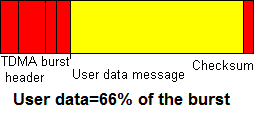
Above User data = 66% of the burst.
iDirect has some clever method of dealing with occasional short bursts for SCADA applications where there may be very many sites transmitting small amounts of data, such as remote weather stations, pipeline monitoring etc.
There is inefficiently in TDMA due to:
. guard time gaps between the bursts, to allow for burst timing error
. the burst preamble, to allow the hub burst receiver time to lock up
. inability of the system to fully fill the frame, without unacceptable congestion at times.
. necessarily gaps to allow burst acquisition, without unacceptable burst collision and congestion at times.
Hope that helps, Eric.
|