|
|

| SatSig Topics Index › LEO forum: Starlink satellite service › Starlink satellite internet now licenced in the UK. |
SatSig topic: Starlink satellite internet now licenced in the UK.(Read 2106 times) |
|
Feb 18th, 2021 at 7:29pm
Using satellites in low height orbit (240 miles or 550km) minimises the propagation delay (latency, 20 to 40mS)) and when accessing the internet this makes the service similar to a terrestrial fibre connection. Previous satellite systems have used high, geostationary satellites, where there are long delays due to the distance. Such geostationary service are problematic for time critical on-line trading and competitive multi-player game applications. Starlink has been given a licence by OFCOM to operate in the UK. Starlink has had a number of 'beta' customers in the northern US and southern Canada since before Christmas. Now 'beta' customers are being sought in Australia, Greece and the UK. Costs are reported to be about £500 plus about £90 per month, with download speeds for 50 - 150 Mbit/s and upload 15 - 25 Mbit/s. Go to their web site ( https://www.starlink.com/ ) to see pictures of the customer antenna. The antenna is disk shaped, flat on top with a rounded cover underneath. At first sight the disk appears to be balanced in the middle on the end of a vertical pole. Underneath at the end of the pole are two electic motors which enable the antenna to be pointed up and down in elevation and also rotated on the top of the pole. The antenna is flat and is not a traditional parabolic reflecting surface with a single feed but phased array made up of tiny patch antennas, each receiving and transmitting individually. |
|
Feb 22nd, 2021 at 2:58pm
The downlink power (watts) from a GEO orbit satellite is spread all over the beam coverage area, which is typically a whole continent or country, in the case of older satellites. This is fine for multi-destination broadcasting where there are many receive sites throughout the service area. In the case of internet access service the downlink carrier from the satellite has been giant high speed carriers (DVB-S2) carrying a stream of data packets to all customers and with the customer modem extracting only the data intended for them. Given the objective is to transmit each signal packet from the satellite to a specific earth station we really need one spot beam per customer. The smaller the diameter of the spot beams the better. Laser beams would be ideal! At GEO height, to obtain high throughput (HTS), satellites need a large downlink antennas and higher frequencies like Ka band to produce small spots and even those spots are still quite large (0.5 deg diameter or 300km diameter, from height 38500km). . The use of low earth orbits (LEO) means less range for the beams to spread out, allowing tiny cell-sized spots to be created even at relatively 'low' frequncies like Ku band. The initial v1 Starlink satellites use Ku band (10.7-12.7 GHz RHCP) for the downlink, using a phased array satellite antenna approx 0.6m square, to transmit multiple small spot beams. Each spot is only about 3 deg or 30km diameter, 550km height. |
|
Feb 22nd, 2021 at 3:23pm
On 20th Jan 2021 Starlink launched a further 60 satellites. Total launched so far is 1015 and of these 951 remain in orbit. 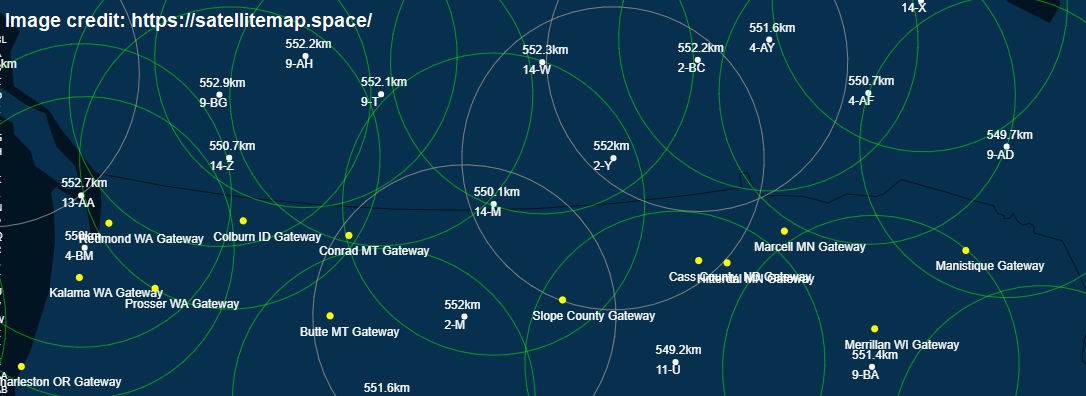 Satellites and Gateway sites along the Canada / US border See live satellites here: https://satellitemap.space/ This web page shows a live picture of where they all are and also by clicking on any particular satellite it shows the altitude height and orbital plane parameters. There is also a list of all the ground Gateway earth stations. Inter-satellite links are not in use so you can only use satellites that are in range of a Gateway. |
|
Mar 8th, 2021 at 2:31pm
Here is a report from a Beta user about their UK use of Starlink satellite internet service in a rural location. https://www.teslarati.com/starlink-rural-uk-review/ |
|
Mar 10th, 2021 at 8:39am
From email: "Starlink is now available in parts of Wales, Scotland, Northern Ireland and northern England, in addition to existing service areas in southern England. During beta, users can expect to see data speeds vary from 50Mb/s to 150Mb/s over the next several months as we enhance the Starlink system. There will also be brief periods of no connectivity at all. As we launch more satellites, install more ground stations and improve our networking software, data speed, latency and uptime will improve dramatically. To check availability for your location, visit starlink.com and re-enter your service address. If Starlink is not yet available in your area, you can place a deposit to hold your space in line for future service. " 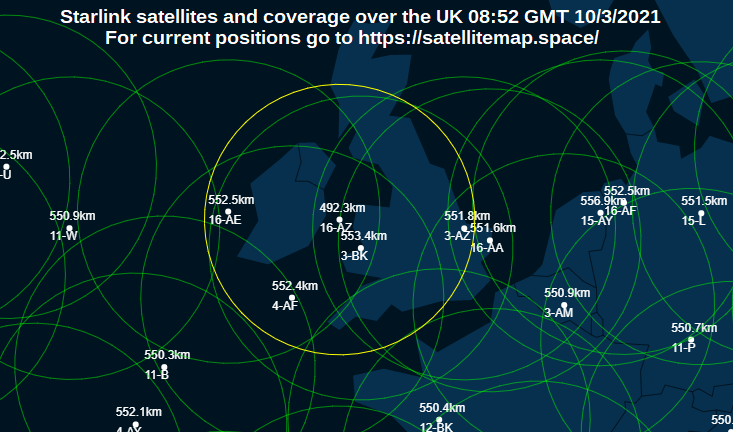 This map from https://satellitemap.space/ shows the instantaneous positions of Starlink satellites at 08:52 GMT this morning. The coverage circles show satellite visibility. You need to go to the satellitemap.space web site to see the moving satellites and identify which are active. Also, note that even if active a connection to the terrestrial internet will require that a nearby ground earth station gateway must already have been installed and working. During the initial Beta phase, while more satellites are being launched and new ground gateway sites being installed there will be brief breaks as the coverage patterns move across your site. Do join the Beta program at starlink.com if you need a fast internet connection. |
|
Email me:eric@satsig.net |