|
Dec 7th, 2021 at 4:32pm
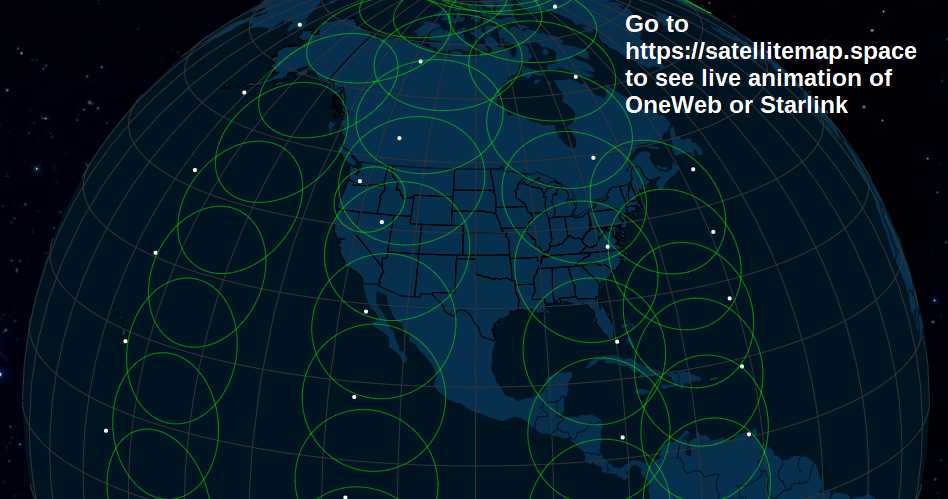
The circular coverages on the image above look wrong to me. I think that each OneWeb satellite has 16 beams, arrayed north-south of each other, with each above/below the next, so the coverage of each satellite is essentially a square. Each of the 16 beams is highly elongated east-west and narrow north-south.
Does anyone agree with this below ?
Ku band customer beams (down 12.75-13.25, up 14-14.5 GHz).
16 Ku band beams, wide east-west, narrow north-south.
Each satellite covers a square area of 48 deg x 48 deg,
Ku band antennas: each comprising a single row of 32 rx/tx patches. Length 1m.
Coverage Beamwidth (-3dB) = 48 deg x 3 deg
Area = 113 sq deg. Equiv circ = 6 deg radius.
Gain = +24.3 dBi beam centre +21.3 dBi beam edge.
Uplink G/T = 24.3 - 10log(325) = -1 dB/K (at beam centre)
Uplink G/T = 21.3 - 10log(325) = -4 dB/K (at -3dB beam edge)
* calculation revised 6 Jan 2022. Note sure what figures to use for antenna efficiency or uplink noise temperature. For time being I am assuming all patches are the same (~100% eff) and earth + LNA = 325 deg.
|