|
Apr 1st, 2024 at 11:56am
Here is some extra advice about Bell satellite dish pointing.
General guide:
Set the dish elevation carefully and then boldly swing the dish sideways to find the wanted satellite. Peak up on both az and el.
Details:
Set the pole accurately vertical and set the elevation angle on the scale. If the clamp is initially slightly slack the LNBF will sag a bit and adding 2 deg to the elevation angle will help. This 2 deg should disappear when all is peaked up and tight.
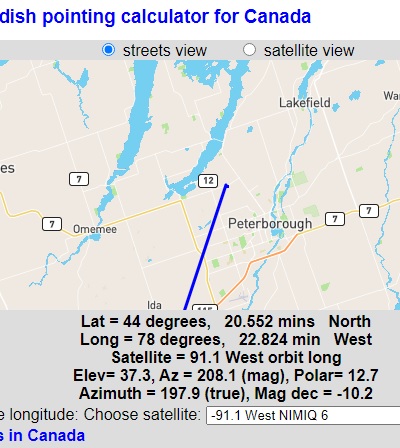
Note the direction line on your house image and acrossthe garden. You can judge the approx sideways direction considering garden fence corners, adjacent buildings etc.
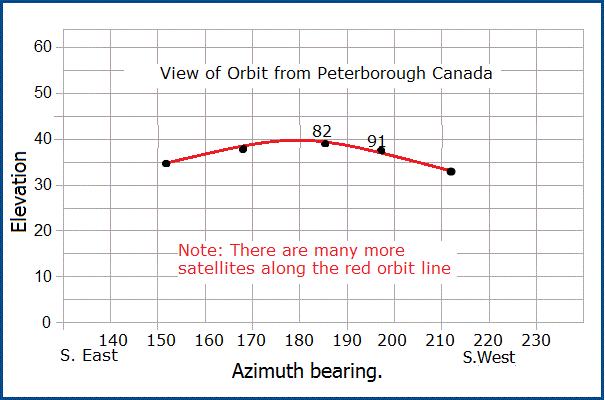
As you boldly swing the dish sideways around the az direction be alert to even the slightest signal, which may then be peaked up. When you look due south you are looking at the top of the curved orbit line. For you, at 78 west deg site longitude, 82 west is just west of due south and thus near the top of the geostationary orbit where there are several more satllites, either way, in an approx horizontal line. Futher to the west the satellites will be lower down.
You may well find the wrong satellite, in which case move along till you get to the wanted one.
If you seem to get nothing at all, check the coax cable connections. Turn the power off and verify good center pin and good braid connections both ends. Remove any braid fragments that may be short circuiting the power supply.
Familarise yourself with the Bell set top box instruction manual, particularly anything about initial acquisition of the satellites and dish pointing.
You mention aiming for two different satellites.
Some antennas have a dual or triple LNBF and in such cases the composite LNBF will need the be tilted slightly clockwise (polar angle), while you are facing forwards towards the satellite in the sky. The lower feed will correspond to the higher elevation (82 deg) satellite. Set the elevation scale to the average value. The small amount of clockwise rotation will correspond to the slope of the red line between 82 and 91. The distance between the two feeds may well be preset to suit sites across Canada and satellites 9 deg apart. Triple feeds are possible for 82, 86.5 and 91 satellites with 4.5 deg spacing.
|