|
|

| SatSig Topics Index › TooWay and KA-SAT satellite › Anybody using TooWAY in UK? |
SatSig topic: Anybody using TooWAY in UK?(Read 31683 times) |
|
Mar 30th, 2008 at 11:04am
As a newbie, I would like to ask if anybody has experience of using the TooWay product in the UK. If so, was installation straightforward, does it perform as advertised and is it reliable? Perhaps more importantly, what is customer support like? Any thoughts or observations gratefully received. Thanks in advance, Tony |
|
Apr 4th, 2008 at 9:42am
Is there anybody in northern Europe that is willing to pass on their experiences - good or bad? Thanks hopefully, T. |
|
Apr 4th, 2008 at 1:02pm
|
|
Apr 4th, 2008 at 1:49pm
I would like to hear from users about how well the relatively new service works and in particular how the "sliding time window" usage policy works out in practice. Is it satisfactory from the user's point of view I wonder or too restrictive? Thanks, T |
|
Apr 6th, 2008 at 7:36pm
|
|
Apr 6th, 2008 at 8:46pm
https://www.satsig.net/tooway/tooway-satellite.htm and some useful pictures of the dish etc here in Spain by El Molino: https://www.satsig.net/tooway/tooway-satellite-from-el-molino.htm You will be amongst the first ever Ka band customers in the UK. Please tell us about it and send images etc. We want you to succeed. For UK dish pointing go here https://www.satsig.net/maps/satellite-tv-dish-pointing-uk-ireland.htm I am particularly interested in the polarisation scale behind the dish and how the figures match up with the calculated angle. My convention is zero angle initially followed by the adjustment. A clockwise adjustment, as viewed from behind the dish and looking towards the satellite is a positive adjustment angle. I want to know if the scale is like that. Some manufacturers reverse the signs on the scale, or start at 90 deg. Best regards, Eric. |
|
Apr 7th, 2008 at 1:29pm
Presumably RS100 is a professional with the appropriate test equipment and experience. I believe the danger is in causing cross-polarisation interference to other users if you get it wrong! I have also been put off TooWay because living in SW. Wales, I have been told that an install could cost £100-£300. Other off-putting features are the 18 months contract and the monthly pricing in Euros since the pound is falling steadily making costs 18 months ahead unpredictable. |
|
Apr 7th, 2008 at 6:52pm
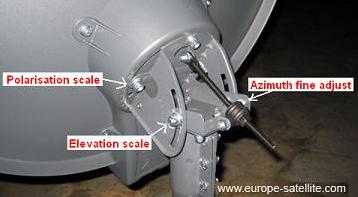 Note that the entire dish and subreflector and TRIA is all rotated as one complete item to set the polarisation angle. Don't worry about doing it yourself. Have confidence; we can help you here if necessary. Compared with satellite TV, the main difference is that far more attention must be given to the pointing accuracy (as well as setting the polrisation to +/- 1 deg). The receive beam, where you make adjustments, is narrower than the transmit beam so it is very important to get to the exact centre of the receive beam, even if this makes no detectable difference to the receive quality. Off pointing slightly each way to get exactly equal degraded signals and then halving the distance works well. Be careful not to stress the dish shape. At 29.6 GHz the wavelength is about 1 cm and the dish surface shape must be accurate to 1mm, preferaby 0.6mm, so be careful tightening up the screws that attach the dish to the mounded boss. Don't force anything. Regarding test equipment, the receive cable is L band but the problem will be the lack of lots of big signals, so a spectrum analyser would be ideal or some specific installer measuring device with filters, as used in Wildblue. There are only 2 transponders on a polarisation, see below: 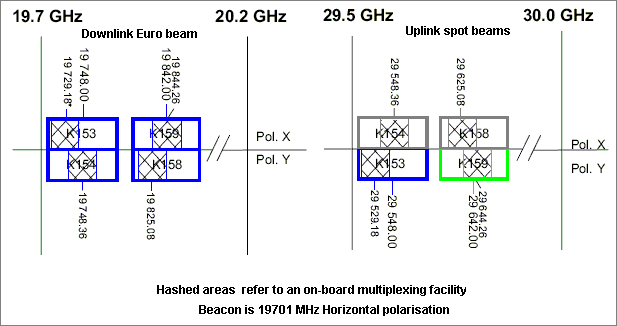 In the absence of a spectrum analyser, my inclination would be to use the Tooway modem and a PC and use whatever signal quality readout is available on the screen, but you must obviously have the PC screen at the antenna to do this. I would set the polarisation and elevation angle accurately, then swing the dish boldly and find the satellite on the first swing. If there is no PC quality readout, adjust very carefully till it just fails each way, mark and then halve the distances. Best regards, Eric. |
|
Apr 8th, 2008 at 11:15pm
Back to my original thread question though, I would really like to hear from existing users if there are any, just how the service is working out. I am concerned that I might get locked into an 18 month contract with a situation such as digruntled "Gigge" describes in the Wildblue forum:- "It appears Wildblue thinks the ability to read webpages a few seconds quicker than what you could with dialup is good enough to keep an account. Wrong. Things have gotten progressively worse on all fronts of what has boiled down to just a rather expensive browsing option. I used to be able to bank/pay bills online. I no longer can because lag, time outs and pages not loading break my session with the secure server. Same applies for vendor websites when trying to make a purchases online. Experiences with the WestMarine, Apple, Audible and numerous other online vendors are no better, and in fact, in many instances worse than using dial up. No confidence what so ever in using wildblue for any type of financial transaction. ". Not good eh? Hopefully TooWay is much better. Best wishes, T |
|
Apr 18th, 2008 at 9:00pm
It also seems that if I am going to "go for it" I will need to install my own dish as I can't find anybody able to even give me a quote at my very rural location in west Wales (near Lampeter). It's a bit scary - if I can't set up a working system there is no "installer of last resort" to help - except of course hopefully this forum! Using the Satsig calculator I have established elevation, azimuth and polarisation angles this last being -12.77deg. Further down the page I see a note that Hotbirds are subject to a +3.5deg clockwise tilt. I assume this means that I would need to set the scale to -12.77+3.5 = -9.27deg. is it as simple as that? I believe that if the polarization is not set to the +or- 1 deg precision, the system may still work but The Hub will not be amused because of cross-polarisation interference to other users. It may seem a silly question but how does The Hub inform you and by what means do you remedy the situation when the Hub is in Turin, Italy. It would be nice to know in advance. Thanks for your patience. Kind regards, Tony |
|
Apr 18th, 2008 at 11:46pm
Don't worry about the install, we can help you with advice here. Regarding the polarisation adjustment, I expect with the large scale on the back that you wll get good enough results just by setting the scale. If Skylogic, Turin, measure too much cross pol they can tell you by phone and ask you to turn the back of the dish by 1 deg. If that movement is successful then carry on the same way etc. If it gets worse go in the opposite direction. This sort of adjustment of a few degrees one way or the other is quite normal and is no big deal. We will need to clarify if the Ka band beams are in fact aligned with the earth's axis. The 3.5 deg offset applied to Ku band beams. I would use just the -12.77 deg polarisation angle, to start with. Best regards, Eric. |
|
Apr 19th, 2008 at 5:08pm
I was told by Bently Walker that they had customers who had gone live with TooWay, they did not say where however. I asked them a few days ago whether they could confirm that the +3.5 deg. tilt on the horizontal polarisation axis did apply. The person who answered the email said he did not know and would copy my question to the technical dept. I have heard nothing since so presumably there is some doubt about the situation. I am now very tempted to give it a go subject to a look at the terms and conditions which I have not seen yet. Thanks for your enthusiastic support so far. Best wishes, Tony |
|
May 11th, 2008 at 8:38pm
Hardware assembly was straightforward with no problems encountered and I am as certain as I can be that all is present and correct. Dish mounting went ok and all is securely fixed to the wall of my stone farmhouse. Now the problem bit; I have spent 2 unproductive hours trying to get an RX lock signal on the Viasat modem. According to the SatSig calculator, for Hotbird 6 @ 13 deg E. I need an azimuth of 163.57 deg. mag. elevation angle of 28.35 deg. and polarization angle of -12.77 deg. here in west Wales. I am certain that the mounting spigot is vertical in all directions by spirit level so these angles were set up accurately on the appropriate scales to start off. The RX LED. flashes at about 1 Hz. but with an uneven mark-space ratio, the on period is noticably longer. I have tried 5 traverses today with elevation @ 28.5, 29, 30, and 31 degs. and - 12.77 deg skew. I also tried briefly with the -12.77+ 3.5 = - 9.27deg. skew angle but this made no noticeable difference. Has anybody any ideas as to what I might not be doing correctly please, am I not traversing slowly enough for the modem to "aquire" for instance, although I went fairly slowly. Help will be gratefully received! Thanks. Tony |
|
May 12th, 2008 at 9:34am
1 flash acquiring 2 flash ranging 3 flash registering 4 flash software download ON completed or slow blink acquiring fast blink ranging / registration ON completed very fast blink modem fault Either way, when the dish gets near the satellite the display should go quickly to double flashing mode. Moving the dish equally either side away from the satellite should cause it to drop back. Set in the middle. Other info.. If you had a power meter in the RX cable then you could peak up on the scale. These Tooway modems seem to come pre-programmed to the relevent downstream frequency and require no customer configuration at all. Best regards, Eric. |
|
May 12th, 2008 at 4:44pm
Unfortunately I have not been able to get more than a 1 Hz. flash from the modem all day, although I have tried a range of elevations from 26 - 31 degs., the calculator showed 28.35 degs. for my location. I have also tried a range of polarizations from - 7 to - 13 degs. the calculator showed -12.77degs. I have moved the dish slowly from about 155 to 175 degs, the calculator shows an azimuth of 163.57 degs mag. I tried using my Horizon MiniSat meter to find the satellite but the reading is very small above the noise floor and I did not improve on the 1 Hz. flash rate. I spoke to BW. this morning and was told that the beam was very narrow and required very precise setting, this I have been trying to achieve but with no success so far. Please are there any techniques I could try to get this set up to work, it's going to be a very expensive paperweight! Thanks for your tolerance if you have read this far Regards, Tony |
|
May 12th, 2008 at 7:11pm
Check the cables are not crossed over. Check the F connectors. The centre pin should stick out 2mm above the surrounding rim. The braid must make good contact inside the outer metal sleeve. When screwed in the centre pin must actually go in properly and not push back the cable. If you point the antenna at the ground or put your hand over the feed (with the transmitter off !) the noise power coming from the LNB should increase slightly. Does the Horizon show this effect ? Regarding finding the satellite, try a much wider azimuth sweep, from east to south. The beamwidth is at least 3 deg wide for finding the satellite, although you should peak up to an accuracy of 0.5 deg. (-3 dB beamwidth = 3 deg for 35cm dia and 19.7 GHz, see beamwidth calculator). Regarding polarisation. A few deg either way will make no problem finding the satellite. If there is some misunderstanding then there may be a much larger error. A - 12.7 deg polarisation adjustment should involve either starting with the feed arm at the bottom and then turning the dish 13 deg anticlockwise while facing towards the satellite or starting with the feed arm at one side and then turning the dish 13 deg anticlockwise while facing towards the satellite. I can't see how your scale is marked. Concern yourself with the amount of adjustment movement needed and the direction, rather than what any scale numbers may say. Polarisation setting is a two step process, first set to a nominal start position, exactly horizontal or vertical, then apply an adjustment angle, as calculated, while facing towards the satellite. Best regards, Eric. |
|
May 12th, 2008 at 8:41pm
The cables (twin) are ok, I did run my Fluke them initially to check for braid/conductor shorts as always with co-ax. Continuity is ok also. BW. thoughtfully colour coded one side each end to prevent mis-connection. Unfortunately the LNB (and BUC) need 30volts so the Horizon can only be used with the TX powered up. I am puzzled by the 3 deg. beam width, I have been carefully moving in much smaller steps than that believing it to be a requirement. Swinging the azimuth more than 15 deg. east will cause a 6 inch dia. post to just impinge on the lower dish beam at 28 deg. elevation but west is unimpeded so I will try what I can. Regarding the polarization scale, 40 deg is at the bottom, 140 deg. at top and 90 deg. is at 9 o'clock and is horizontal. I am setting it at 102.77 deg. or there-abouts to achieve - 12.77 deg. ie ACW. looking at the satellite. Thank you so much for your help so far, I am beginning to wonder if there might be a problem in the equipment but prefer at this stage to blame myself! Best wishes, Tony |
|
May 12th, 2008 at 10:34pm
With the mains power off, it will be safe to disconnect the transmit cable at both ends and the receive cable at the LNB/TRIA end. Then, taking great care to avoid shorting the outdoor end of the receive cable, check for 30 volts at the outdoor end. This will verify that the colour coding is correct. If the coax is a twin-shot cable where the two are joined side by side there may be an additional coding - some regular printed or molded marking that only appears on one cable. This will alternatively verify that you don't have a cross over ? What do the markings say on the two TRIA and the two modem coax sockets ? I don't know how the Horizon meter works. It may be that you need to pre-charge its battery and have it powered on using its internal battery to make the display work, even if you are powering the LNB using 30v from the indoor modem. I wonder too if +30 volts isn't rather high for a Horizon meter. I don't know. 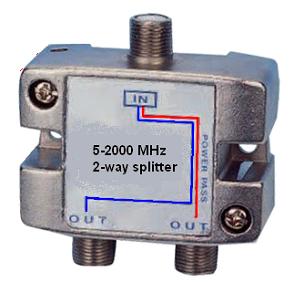 In these situations I often use a 2 or 4 way L band splitter and feed the LNB DC power via the DC pass path and put a DC blocked path to the meter device. The polarisation makes some sort of sense. I think the back end of the feed support arm is now a little to the right of the bottom, as seen from the rear, while facing the satellite. Is this the case ? You are welcome to send images to eric@satsig.net and I can incorporate them here. Was the feed horn and the TRIA electronic box pre-assembled? If not, was there any alternative way the feed might have been fitted to the electronics ? 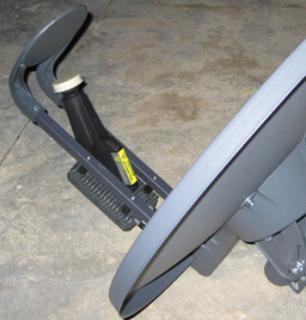 It should look like this above. Best regards, Eric. |
|
May 13th, 2008 at 10:18am
Horizon confirm that the MiniSat can't drive the LNB as 30v is needed, they suggested powering it via the TX side which I do. A very small peak is visible on the meter when on the satellite bearing but the modem does not lock on to this. The TRIA unit came ready assembled, not input from me was required. The connectors are labelled clearly TX and RX and the modem has pictures of dishes with arrow in and arrow out - all very fool proof! Thanks for your patience I am beginning to think there might be a hardware problem perhaps. Regards, Tony 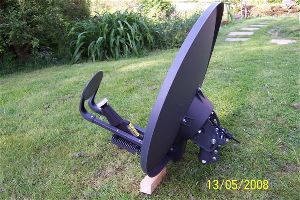 Image above inserted by Eric. |
|
May 13th, 2008 at 11:13am
That does not sound right to me. The TX side of the modem should NOT be connected to the Horizon Minisat. The TX side of the modem should be connected to the TX side of the TRIA (the outdoor transmit-receive-integrated-assembly). The RX side of the modem, which also has a similar +30 volts on it, should go to the RX side of the TRIA. If Horizon are happy with their device being connected in a 30 volts circuit then their device should be connected into the receive cable, NOT the TX cable. The Horizon device is like a crystal set with a wide band noise measuring capability and noise level display. It measures noise from the LNB, from the ground, from your hand, from satellites, from the sun. The small peak you see on the meter is encouraging. If this peak appears and disappears as you pass the satellite then peak up on it using azimuth and elevation adjustments. There is only one Ka band carrier from W3A satellite so it is not like looking for Astra or Hotbird in Ku band, which have multiple carriers and a thus a high composite power level. Having peaked up, power off and remove the Horizon meter, reconnect the receive cable and power on again. I have phoned BW in case they can help you. Best regards, Eric. |
|
May 13th, 2008 at 12:09pm
I see that this is the recommended method for WildBlue if you don't have the add-on power supply for the SuperBuddy meter. Sorry for the confusion. Bentley Walker have emailed photos of their set up and as far as I can tell, my polarization setting is in the right order, it's certainly not the wrong polarity tilt. I am considering re-locating the dish just to see if local interference from an adjacent post etc is a cause of the problem. It is not in the line of view to my eye though. I am really grateful for so much assistance in my hour of need, thank you. Regards, Tony 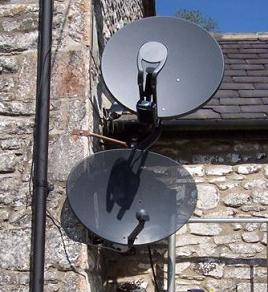 Image above inserted by Eric |
|
May 13th, 2008 at 1:39pm
Then disconnect the Horizon, and with the power off connect up the RX cable between the modem and the TRIA. The small increase may be due to noise being received via an obstruction. You should see increase in the noise level if you point the dish at the ground or put your hand over the feed. In your picture I can see a nearby drainpipe. That is not the problem. There may however be a phone or power line cable or similar. I can see a sun shadow. That could have an effect but not enough to stop reception altogether, but enough to give a small noise indication on its own as it will reflect noise from the ground. Best regards, Eric. |
|
May 13th, 2008 at 3:31pm
Just to make certain none of these factors is the cause of the problems I am having I am making a ground frame mounting that I can move around to different locations with the TooWay dish assembly. The MiniSat meter is just about usable but the signal "peak"which is real I believe because it co-incides with the Hotbird 6 compass bearing, is difficult to see superimposed on the background level. It is brilliant that I am receiving so much assistance, I feel we will resolve it in time! Thanks. Best wishes, Tony |
|
May 14th, 2008 at 8:32pm
Having positioned the dish away from potential interference sources and been given the skew and elevation settings in use by the Bentley Walker set up, I corrected them for my more westerly location, connected up the little Horizon MiniSat and found to my surprise that the signal indicated was much larger than expected. Noise floor was about 2.5 RF.units and I was able to peak up at 3.1 or so. Having locked the bolts and disconnected the meter, I re-connected the LNB co-ax, switched on the modem and waited. Initially nothing ,then a 1 Hz. searching LED. and suddenly the software updating phase was under way. This complete and the RX. lock light lit and was steady! Satellite found and ready for the next stage of setting up. One recomendation I would make is a meter is really important. The ViaSat modem is a bit like me, thinks very slowly and any change you make does not have any visible affect for quite some time so the correct setting could easily be missed. The next stage is to refit the dish to the house wall and peak it up finally. With VERY grateful thanks to Eric for endless advice and to James of BW. for supplying their settings that proved that for the Ka Hotbird 6, the extra +3.5 degs. polarization correction is required. Phew! Best wishes, Tony |
|
May 17th, 2008 at 2:34pm
Having got the TooWay dish correctly aligned and with quite acceptable meter readings on the cradle, I refitted it to the original location and immediately found that the readings were less clear. I carried out some removal of obstacles which I had not thought problematic initially and was able to align correctly on Hot bird 6. The final key to the problem was that it was necessary to include the extra +3.5 deg tilt on the skew angle - there had been some doubt about this from the start. After connecting the RX cable to the LNB and switching on the LED started flashing at 1 Hz then 2 Hz. then down-loaded the software required and lit steadily, locked on. Activation was straightforward and the system was up and running really well straight away. I am now learning about its idiosyncrasies and will report back when I have had more experience. My really grateful thanks go to Eric for unstinting efforts to get me, a satellite novice, far enough up the learning curve to succeed and to James of Bentley Walker for his excellent support efforts too. Kindest regards, Tont |
|
Jun 13th, 2008 at 12:47pm
Quote: A further update to the saga. Having got the TooWay dish correctly aligned and with quite acceptable meter readings on the cradle, I refitted it to the original location and immediately found that the readings were less clear. I carried out some removal of obstacles which I had not thought problematic initially and was able to align correctly on Hot bird 6. The final key to the problem was that it was necessary to include the extra +3.5 deg tilt on the skew angle - there had been some doubt about this from the start. After connecting the RX cable to the LNB and switching on the LED started flashing at 1 Hz then 2 Hz. then down-loaded the software required and lit steadily, locked on. Activation was straightforward and the system was up and running really well straight away. I am now learning about its idiosyncrasies and will report back when I have had more experience. My really grateful thanks go to Eric for unstinting efforts to get me, a satellite novice, far enough up the learning curve to succeed and to James of Bentley Walker for his excellent support efforts too. Kindest regards, Tont |
|
Jun 13th, 2008 at 11:19pm
If you do not mind me asking how much did you pay for your system and how mcuh is your subscripion I think it works out about 850 including 4 months service charge in advance and vat and delivery. Sorry to be a bit vague but it is priced in Euros and today 1 Euro = 0.788. Monthly charge for Bronze package is 55 Euros + vat. It's not cheap! but I think it is worth the money based on what I have seen so far. Tony |
|
Jun 14th, 2008 at 5:22pm
|
|
Jun 14th, 2008 at 10:17pm
My experience so far is its not that easy to set it up yourself, unless you are fine to do your own Satellite TV its not recommended you do it yourself. The system was launched as self install, there is not much Ka band in the sky at the moment, so a basic analog meter will find the signal, then use the system itself to fine tune once locked on. However, even for me, after years of installng systems, my first once took a few hours to get it right, which is important if you want trouble free service. Notesconsultants specialise in setting up systems for people, we can install completely or just turn up and set up your installation. Costs vary depending on how much it costs to get to your location, and what sort of subscription you sign up to with us. Our web site is being updated, but it can be found at www.notesconsultants.co.uk |
|
Jun 15th, 2008 at 12:01pm
Tony - how do you rate the browsing? Have you tried any special applications such as VoIP? I have'nt tried VOIP as I assumed satellite latency would not allow good results. I see from some of the WildBlue postings that many VOIP systems don't seem to work. Browsing is excellent, a real pleasure after dial-up. I have posted a speed test result below:- Speed Test Results Date 10/06/08 22:15:54 Speed Down 1604.82 Kbps ( 1.6 Mbps ) Speed Up 195.17 Kbps ( 0.2 Mbps ) Port 8095 Server speedtest2.adslguide.org.uk Link: https://www.thinkbroadband.com/speedtest/results/id/121313250083163025490.html You can give out this URL to other people to show them this speedtest result. Only problem so far is an occassional drop-out which does not seem weather related but nothing to get too concerned about yet. We have not had much really heavy rain here unlike SE. England but there have been no problems in moderate rainfall (11mm. in 8 hours). Very good results so far! Tony |
|
Jun 20th, 2008 at 4:09pm
"Only problem so far is an occassional drop-out which does not seem weather related but nothing to get too concerned about yet. We have not had much really heavy rain here unlike SE. England but there have been no problems in moderate rainfall (11mm. in 8 hours)". [/quote] Ka band is sometimes criticised for being prone to rain "drop out" and although I have had the chance to use it in moderate rain, I have been waiting to see how the inbuilt "rain mitigation" works in serious weather. Wednesday night provided this in spectacular fashion, 60 MPH gales and torrential rain at times. According to my rain guage, 30mm. fell in 24 hours in a series of squalls. The TooWay system just could not cope, it lost RX. lock on a least 5 occasions but tried hard to re-connect each time. The double flashing ranging light kept going and after about 10 minutes each time, it locked on. Unfortunately it could not stay locked and went through the same procedure again and again. The rain was very heavy. Unfortunately, I can't find any way of getting any on-screen signal quality or level statistics so I can't tell at what point the signal was lost. My previous one way system dropped out at between 28-34% signal quality, it is a pity that I am unable to find a way of reading these data for the DOCSIS modem. Does anybody know how to please? I would have been amazed if the torrential rain had not caused problems but at least I know now what to expect, it's a good effort. Tony |
|
Email me:eric@satsig.net |