|
|

| SatSig Topics Index › Satellite Connection in Africa › Problem with iDirect 5000 modem |
SatSig topic: Problem with iDirect 5000 modem(Read 6396 times) |
|
Jun 20th, 2008 at 10:49am
I was working with an iDirect 5000 modem and the signal could not go beyond 6 adn it keeps on going out of the network.Lnb is pll 3120.Tried to adjust the signal but no change Could the modem be the one faulty or the LNB.Need a sol ASAP as the client is on my neck |
|
Jun 20th, 2008 at 12:37pm
Degraded cable connector, particularly at the LNB end. If moisture gets into the F connector and cable, then the centre pin corrodes and the foil sheath inside the cable outer insulation deteriorates, possibly over a distance of 12 inches or more back into the cable. With the power off, inspect the cable F connector centre pin at the LNB. It should be bright copper colour (not black and shrunk) and the pin should stick out 2mm proud of the rim. If the sheath is corroded you will need to strip back the insulation till you find good cable and remake the connector. Use really good sealant on the outside of the new joint. If the centre pin is corroded take a 3 inch length of centre pin wire and use it to poke in and out of the LNB socket in an attempt to clean the inside capture springs of the LNB socket. Electronic contact cleaner/silicone electronic contact grease may help. Examine the full length of the cable, looking for damage. Is the indoor modem connector good ? The dish may have moved. If is loose on its mount, adjust and retighten. Faults in the LNB or modem are rare. Check that the hub has not recently changed the outlink (downlink) carrier symbol rate or frequency, without telling you. The modem should be in a cool, dry place. If the whole system is new then you have probably not yet found the satellite. Check the modem tuning configuration. Check the antenna polarisation. Ask what the receive and transmit polarisations should be. Crossed polarisation, i.e. RHCPdown/LHCPup or LHCPdown/RHCPup is normal, but there are some people operating co-pol with either RHCPdown/RHCPup or LHCPdown/LHCPup. Linear polarisation, both cross-pol and co-pol, is also used in some instances. If you are uncertain find out from the hub what you are supposed to have configured and ask for feed assembly instructions/diagrams. Once you have the feed assembly correct, set the beam elevation accurately. Swing the dish boldly and find the satellite. Best regards, Eric. |
|
Jun 20th, 2008 at 12:47pm
Thanks for the info.The checks you have mentioned I already did them and even tested with another cable and the same result was observed.I even re-peaked the antena and the signal could not improve.Did crospol with the Hub but funny enough when the power on the modem was increased ,it could not reflect on the other side of the Hub. |
|
Jun 20th, 2008 at 12:53pm
If it is an old system is there water in the feed, transmit waveguide / coax ? Is the BUC cable good. It takes a high DC current and contacts corrode very rapidly with moisture. If new, is the antenna assembled correctly ? Did all the panels fit together perfectly with no stress ? Larger 3.7m dishes need very delicate attachment to the mount steelwork with correct spacer tubes etc on the right bolts. The rim must be flat. Do the feed arm side struts go into the correct holes in the feed arm ? Does the feed polarisation type and set up make sense?. Best regards, Eric. |
|
Jun 20th, 2008 at 12:56pm
|
|
Jun 20th, 2008 at 1:03pm
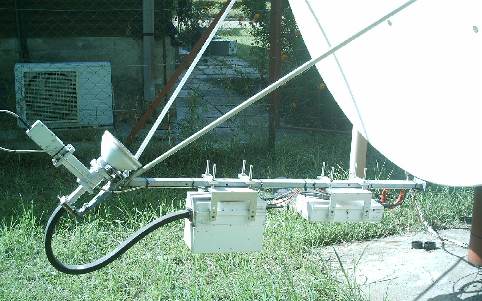 Your picture shows a C band linear cross-pol feed with vertical transmit and horizontal receive polarisation. If the broad faces of the LNB waveguide are on either side then that sets horizontal receive polarisation. No polarisation adjustment angle appears to have been applied unless the adjustment required was near zero or near +/- 90 deg. Where are you located and what is the satellite, and what nominal downlink polarisation have you been told to receive ?. If you are close to the equator and operating at low elevation angle then the polarisation adjustment required will be large, see https://www.satsig.net/maps/satellite-dish-pointing-west-africa.htm For example (1) Nominal horizontal polarisation is parallel with the equator. If you are near the equator and look straight up the polarisation line is in an east-west direction. If you look low down towards the east or west horizons the polariation line is vertical and the adjustment needed is about +/- 90 deg. For example (2) Nominal vertical polarisation is parallel with the earth axis. If you are near the equator and look straight up the polarisation line is in a north-south direction. If you look low down towards the east or west horizons the polariation line is horizontal and the adjustment needed is about +/- 90 deg. If you have a spectrum analyser try turning the feed all the way round. The signal should go down to a sharp null at the worst position and up to a broad maximum at the best position. The opposite polarisation, unwanted interfering, signals will do the opposite. You need to find the exact null and then turn the feed 90 deg. You are pointed at a very low elevation angle. I would put a strip of wood under the lower edge of the dish, put an inclinometer on the wood and adjust for the beam elevation angle. Get someone to hold the wood strip while you put your head behind and under the dish and look along the wood. Does the lower edge of the beam go clear over the top of the fence ? The weight of the BUC and booster amplifier is heavy and will tend to pull the sides of the dish forwards. Try the crossed string test with lines up/down and across the front of the dish. They should just touch. See: https://www.satsig.net/pointing/rear-side-struts.htm Ideally you need rear side struts to pull the sides of the dish backwards, to take the strain. The problem is normally evident at Ku band where the dish shape tolerance is smaller. Please say what is the antenna size, manufacturer and model number (e.g. 1250, 1252, 1244, 1183, 1184, 1194 etc.) I want to check that the side struts are in the correct holes in the feed arm. It depends on model number. Best regards, Eric. |
|
Jun 21st, 2008 at 12:18pm
|
|
Jun 23rd, 2008 at 3:18pm
|
|
Jun 23rd, 2008 at 3:49pm
Ask your hub what is the name of your downlink polarisation. It will have a name, either Horizontal or Vertical. Where are you located ? What is the antenna model number ? Best regards, Eric. |
|
Jun 25th, 2008 at 5:08pm
Regards, Jane |
|
Email me:eric@satsig.net |