|
|

Ku band VSAT BUC sale
New Ku band BUC are for sale, direct from the manufacturer, Nexgenwave.
Power output is 0.25, 0.5, 1, 2, 3, 4, 6, 8,10, 16, and 25 watts with Standard, Extended, and Super-extended operating frequencies (M&C optional).
|
|
|
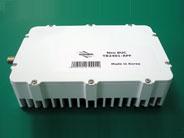
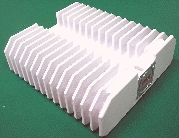
BUC description
A BUC is a Block Up-Converter. It is transmit device normally attached direct to the transmit waveguide input of the filter/feed assembly of a VSAT (very small aperture terminal) dish, used for satellite communications internet access from the home, small office etc in locations away from good terrestrial data network infrastructure. The cable from the indoor satellite modem supplies DC power and carries a 10 MHz frequency reference plus the actual signals to be transmitted. The signals to be transmitted are in a 500 MHz wide band, between 0.950 - 1.450 GHz in the cable, which will be up-converted in a mixer to Ku band (14- 14.5 GHz) microwave frequency, using a local oscillator translation frequency of 13.050 GHz. So Output frequency (GHz) = Input frequency (MHz) + 13.050 GHz. The standard Ku band BUC gives 14-14.5 GHz out for 950-1450MHz in. Extended and super-extended frequency ranges give 13.75-14.25 GHz out or 13.75-14.5 GHz out.
A 2 W BUC with output frequency band 12.25 - 12.75 (input 950 - 1450 MHz, local oscillator 11.3 GHz) is also available. You could use this to help build your own satellite.
Stability of the output frequency is important so the local oscillator is locked to a 10 MHz frequency reference. If this 10 MHz signal is absent and the phase lock loop (PLL) control of the LO frequency becomes unlocked then the BUC output is muted to prevent the output carrier being transmitted on the wrong frequency where is might well cause interference to other carriers in the satellite transponder.
These BUCs come direct from the NEXGENWAVE who is the manufacturer in Korea and you will pay them directly and receive your BUC direct from them. When you complete the order form your contact details and the type and quantity of BUCs required will be sent to them. They will then give you a quotation including shipping costs. You yourself may be responsible for additional taxes, VAT, customs duties etc. Your contract is direct with the BUC manufacturer, Nexgenwave, address: Si-Cox Tower #621, Sangdaewon 513-14, SeoungNam City, 462-120 Korea. Tel: +82-31-777-9912 Fax: +82-31-777-9916
BUC technical specification (example)
| BUC Input frequency range | 950 - 1450 MHz |
| Input impedance (F type connector) | 75 ohm |
| BUC Output frequency range | 14 - 14.5 GHz |
| Output power @ 1 dB compression | min 30 dBm (1 watt model) min 33 dBm (2 watt model) min 36 dBm (4 watt model) |
| Output connector | WR75 waveguide |
| Frequency sense, local oscillator freq. | Non-inverting. LO=13.050 GHz |
| Linear gain | Min: 50 dB, max 60 dB |
| Gain variation | 1.5 dB p-to-p over 54 MHz, 4 dB p-to-p over 500 MHz 4 dB over operating temperature range |
| Spurious - in band - out of band - in receive band |
<= -23 dBm <= -45 dBm <= -70 dBm |
| Mute output power with LO reference unlocked | <= -45 dBm |
| In band noise emission | <= -95 dBm/Hz |
| Receive band noise (10.7~12.75 GHz) | -160 dBm/Hz |
| Phase noise @100 Hz @1kHz @10 KHz @100 kHz @ 1 MHz |
-60 dBc -70 dBc -80 dBc -90 dBc -100 dBc |
| Required frequency reference input phase noise @100Hz @1KHz @10 kHz |
10 MHz -125 dBc/Hz -135 dBc/Hz -140 dBc/Hz |
| DC supply voltage | 15 to 24 volts |
| Power consumption | 18 watts (1 W model) 20 watts (2 W model) 48 watts (4 W model) |
| Operating temperature | -40 to +55 deg C |
| Storage temperature | -40 to +75 deg C |
| Humidity | 0 - 100% |
| Dimensions (length, width, height) | 170 x 130 x 40 mm (1 and 2 watt models) 200 x 120 x 70 mm |
| Mass | 1.2 kg (0.25 - 3 watt type) 2 kg (4 - 8 watt type) |
Ku band BUC sale: Price request
You need to send an email to Nexganwave requesting a price quotation. Please include full details of your requirements: Contact details: Phone number and full business address, quantity of BUCs required, frequency range, power output, any M&C required, any special requirements.
Click here: sales@nexgenwave.com to create an email.
When you send in your details you will receive a firm price quotation. Warranty is 2 years. Please use recognisable company email address, not private hotmail, yahoo msn etc and do not try to order these items in this BUC sale using stolen credit cards or other frauds. No goods will be dispatched until fully cleared funds have been credited. Avoiding fraud will help keep the cost down for genuine customers.
Safety notes:
People safety: The output of the BUC is microwave power. 1, 2, 4, 8 or 25 watts is substantially less that in a microwave oven (typically 600 watts) but it still has heating power and you must not allow it to heat the human body. Most important is to avoid the microwave power getting to the human eye which has a lens which may be easily destroyed by the heat. There is no blood going through the lens to cool it down. So never look into a waveguide and when the antenna system is working and do not put your head between the feed radome window and the dish or into the cylindrical beam which goes up towards the satellite.
Care of the BUC: BUCs should never be powered on unless the output waveguide is terminated in a suitably rated dummy load or into the intended transmit waveguide of the feed. Incorrect termination (e.g. open circuit or short circuit) of the waveguide may destroy the BUC transistors. The output power may also injure people. Always turn the power on and off from the indoor unit. Do not disconnect the BUC cable with the power on. High voltage transients may damage both BUC and indoor unit. Connect the cable correctly - don't cross over the receive LNB cable with the BUC transmit cable, as this may damage the LNB power supply. When connecting up the WR75 waveguide make sure the rectangular holes align correctly and also with the hole in any waveguide gasket if used. If in any doubt get someone else to simultaneously observe during the assembly. Do not try to operate a BUC at above its rated output power or you may damage its transistors permanently.
Care of the satellite: Always increase the input drive level slowly from a very low level starting point, under phone control from the satellite hub who will monitor your co-polar and cross-polar uplink signals. You do not want to interfere with other people. You will normally be asked to transmit a low level CW, unmodulated, carrier. If the far end are unable to see this CW carrier, don't go on increasing the power; you are probably on the wrong frequency, wrong polarisation or wrong satellite! These BUCs have characteristics specified which relate to their use for single carrier operation below the 1 dB gain compression point. If you want to operate multi-carrier then you need to consult the manufacturer regarding carrier-intermodulation ratio and get advice as to what output back off is appropriate. For example, it may be possible to use a 8 watt BUC to provide two carriers, each of 1.4 watts for acceptably low levels of third order intermodulation product interference into adjacent frequencies. In this example the composite output power is 2.8 watt and output back off is 4.5 dB. i.e. 10 log( 1.4/4) dB
|
The information on this page is based on information provided to me by Nexgenwave. It is for your information and is not a paid for advertisement. For more details, contact Nexgenwave. You are welcome to tell us your experiences in the satsig.net forum. Page last amended 13 August 2015, 18 Mar 2019 HTML5 |