|
|
Antenna gain and beamwidth calculator How to find true north using the pole star |
Explanation of Azimuth and Elevation Correcting VSAT dish distortion |

Using a Magnetic Compass
Using a magnetic compass to find north:
The North N mark on the rotating part of the compass or the Red end on the needle or the Pointed end of the needle points towards magnetic north.
If you stand with the compass in front of you and rotate your entire body and the compass till the North part is directly away from you then you are facing North. If your compass has a white direction line or some aiming arrow feature on the fixed rim then turn the compass till the arrow is pointing directly away from you, in front.
North is defined as an azimuth bearing angle of 0 (zero) or 360 degrees. East (approx where the sun rises) is called 90 degrees. South is 180 degrees and West (approx where the sun goes down) is 270 degrees.
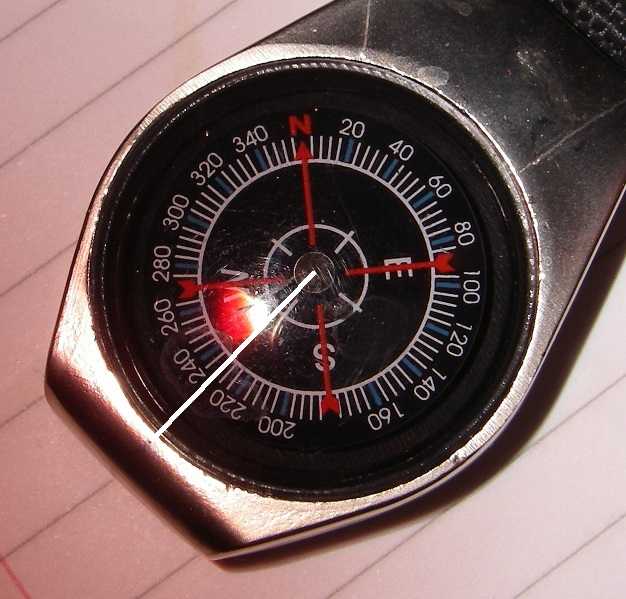
The compass rose. If you held this compass so that the white line was directly away from you and in front of you you would be aimed on a magnetic bearing of 232 deg. The individual tick marks are at 4 deg increments.
Using a compass to determine an azimuth bearing angle:
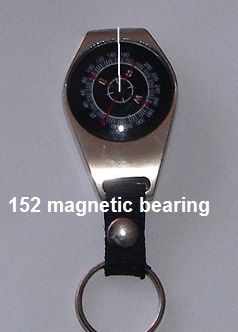
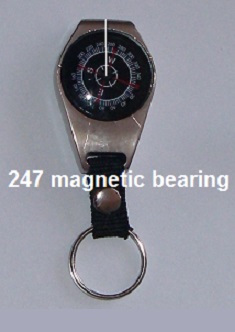
Hold the compass with the ring towards you and sight through the slit in the direction of interest. Read off the magnetic azimuth bearing angle using the cursor line as below:
|
You are looking in the azimuth bearing direction of 152 deg magnetic. |
You are looking in the azimuth bearing direction of 247 deg magnetic. |
If you want to determine the difference between magnetic bearings and true bearings note that this difference varies according to your location on the earth. If you know your location in terms of latitude and longitude try putting that location into the dish pointing calculator and enter a hypothetical satellite on the same longitude as yourself. The azimuth bearing angle will be 0 or 180 deg true north or true south. The approx equivalent magnetic bearing angle will also be given. This works reasonably well for most locations. My earth's magnetic field model does not extend to the polar regions.
|
Page started 12 Feb 2008, amended 18 Mar 2023. |