|
C band interference filters (external link): |
 Home
HomeC Band spectrum threat
If you are operating in C band (3.4 - 4.2 GHz), you are in potential big trouble. I am putting this page here to make you aware of a significant technical threat to your business.
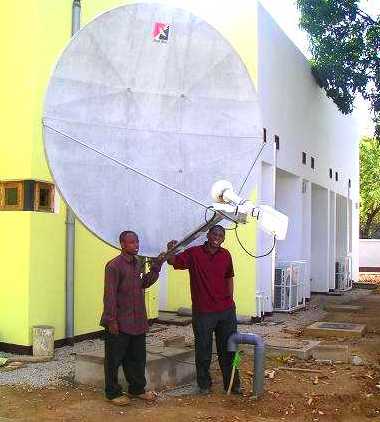
The extended C band frequencies (3.4 to 3.7 GHz) have already been identified by several national administrations for use by new services like Broadband Wireless Access (BWA) and WiMax. In addition, other administrations are looking to deploy these new terrestrial services in the standard C band frequencies (3.7 to 4.2 GHz). In countries where WiMax services have been introduced, there have been significant in-band and out-of-band interference issues and services interruptions for satellite ground stations and their related services. We are aware of interference interruptions which have occurred throughout Africa, and in Australia, Bolivia, the Caribbean, China, Fiji, Hong Kong, Indonesia and Russia.
A Report recently issued by The Office of the Telecommunications Authority (OFTA) in Hong Kong concluded that without the implementation of technical constraints (principally geographic separation and the use of LNB filters) -- which would be costly for both BWA operators and FSS users -- the deployment of BWA services in the 3.5 GHz band would lead to interference problems in the entire C band (3.4 4.2 GHz), making a wide and cost-effective deployment of BWA systems in a small place like Hong Kong difficult. In the conclusions to the Report, OFTA also noted that these interference problems have been increasingly reported in places outside of Hong Kong
In addition to BWA systems, C band spectrum is being targeted for deployment of terrestrial mobile services (IMT). The ITU-R Working Party 8F, responsible for the terrestrial component of Agenda Item 1.4 of the World Radiocommunications Conference 2007 (WRC-2007), has included the 3.4-4.2 GHz frequency range as a potential candidate band for these services.
Broadband Wireless Access and IMT services are similar in that they are both characterised by a large number of ubiquitously deployed base stations and user terminals. FSS satellite systems deliver extremely weak signals which are highly sensitive in both the standard and extended C band frequencies. The most effective solution to avoid interference from these services is to separate the systems by implementing exclusion zones around existing FSS earth stations. The need for exclusion zones has been recognized by the ITU-R (including WP 8F) and several ITU studies within Working Parties 4A and 8F. However, exclusion zones are impractical in the case of ubiquitously deployed C-band antennas (as such zones can not be defined) and for C-band antennas at known locations the width of such zones may go up several hundreds of km, preventing therefore the deployment of terrestrial IMT in large areas. Furthermore, the implementation of exclusion zones would negatively impact the ability of FSS operators to expand operations beyond existing earth stations.
The only effective solution to protect satellite services in the extended and standard C band frequencies is to separate them from terrestrial systems such as WiMax or BWA by several to thousands of kms, or to find other spectrum for these services to operate.
The Global VSAT Forum is asking you to help us help you protect your business from this threat. I urge you to take the following actions:
C band spectrum action plan:
-
Register your receive-only and transmitting earth stations that operate in the extended and standard C band frequencies with your local telecom regulatory authority wherever possible, so that they can be afforded the proper protection against interference.
-
Contact your local telecom regulatory authority, and urge them to prevent the reassignment of C band frequencies to Broadband Wireless Access (BWA) and WiMax services. Present your case by telling them the truth your business will suffer significant service disruptions if these terrestrial services are allowed to operate in the bands you are already using.
-
Urge your telecom regulatory authority to prevent the designation of the C band frequencies as candidate bands for IMT (terrestrial mobile services) services at the upcoming ITU WRC Conference and to contribute to this effect at the upcoming Conference Preparatory Meeting (Feb 2007). Explain that your business will suffer significant service disruptions if these services are allowed to operate in the bands that you are already using.
-
Join the international effort to stop the reassignment of C band to terrestrial services. The issue is being discussed at regional telecom organizations like CITEL, APT, CEPT, ATU and it is certainly being addressed at the ITU in Geneva.
-
Encourage your national government to participate in these international meetings and seek protection for your business. Please participate in these meetings yourself, as a private sector member with a legitimate interest in this important topic.
-
Join the GVF in its effort to speak for the global satellite services industry as we conduct our advocacy on behalf of the spectrum rights of our member companies.
|
Page created 10 October 2006, 21 March 2007, 17 Feb 2015, 27 Jan 2025, 5 April 2026. |