|
|
(C+N)/N measurement and Eb/No Calculator Background to this spectrum analyser project AM1 satellite 40E Vertical and Horizontal polarisation Ku band Spectrums 2007 |

On-line satellite spectrum analyser
This satsig page status = Faulty since 31 Aug 2009.
Meanwhile, I recommend to go to this site: https://satsignature.com/ which provides live satellite spectrum analyser service.
|
This page allows you to select a satellite and observe the downlink satellite spectrum. You input various parameters and after a while an image will return of the satellite spectrum requested. The whole system has taken several months to build and this web page first worked 15 May 2007. The lower left corner shows a long number, representing the time in seconds since 1970, plus the wanted satellite position plus the actual final satellite position from the antenna position encoder, which may differ slightly, depending on where the antenna drive motor finally stops. You can try looking for other satellites in between or peaking up slightly with slightly different positions. |
Please think carefully before use.
|
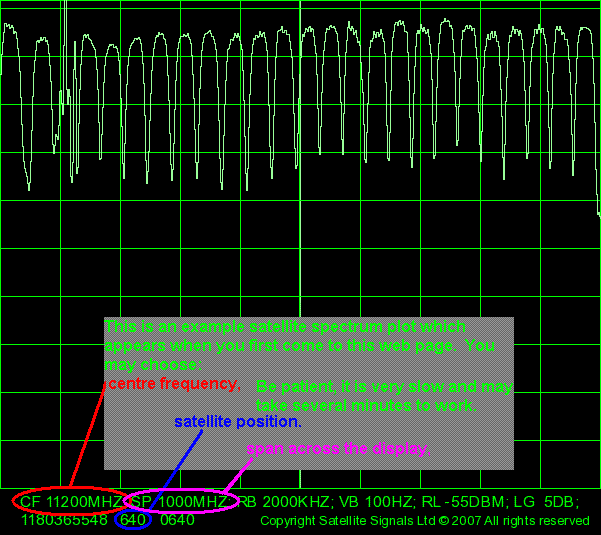
27 Oct 2007: There used to be a compensation for a 5 dB peak to peak ripple. My corrections for this have drifted out of sync and the corrections were removed this evening. Really I need a better quality LNB, with PLL so it is accurate in frequency as well. The ripples in the cable must be due to some termination mismatch problem or regular kinks in the cable.
9 Nov 2007: I have made the image black on white to save ink when printing.
8 March 2009: I am working on getting a remote control polarisation selection option working. This involves getting a TTL logic level (0 or 5V) on a pin on the PIC41202F microprcessor chip to control a +13/+18V power supply to the LNB. Not yet working in the hardware. The software off this html page activated today.
Note the orbit positions and satellite names may be wrong. Moving from one nearby satellite to another will reduce the time of the antenna movement.
This page provides access to an on-line spectrum analyser HP8560A connected to a steerable 90cm Ku band antenna, at approx 52 deg North latitude and 0 deg longitude (in the UK, Europe, near the Greenwich longitude meridian). It is possible to point the dish at satellites over the Atlantic, Europe/Africa region and Indian ocean, eventually to approx 70 deg west and 70 deg east longitude along the geostationary arc. Please note that it takes about 7.5 minutes minutes to re-point the antenna from one extreme to the other, so please be patient. The antenna is presently at ground level so I can make adjustments and does not yet therefore have full visibility of the geo orbit. The satellite frequency spectrum is drawn based on input data that you need to supply. You need to know the downlink frequency and the span (width of the screen display). make the span wide enough to see your carrier. Frequency accuracy is only about +/- 2 MHz, due to temperature and initial error, at the moment. On 16 Dec 2008 at 3pm the error was 1.8 MHz so to determine the accurate frequency of a visible carrier add 1.8 MHz to the displayed value. You may calibrate the system now by going to Telstar 12 at location 487 and tuning to 11451, span 5 MHz. There two Vertical polarisation beacons at 11450.5 and 11451. The upper beacon, 11451 MHz, should be in the centre. Make a note of the frequency error. A suitable resolution bandwidth, sweep time and video filtering bandwidth is determined automatically.
I have put this together at home and not everything works. You are welcome to email me eric@satsig.net but don't expect an immediate response. If the system stops it may not be fixed for several days. Do tell me however, sometimes the disk just gets full and I need to delete some old spectrum plots or log files. At the moment the present operating LNB has a local oscillator frequency of 9.75 GHz. Polarisation is now Receive either Horizontal or Vertical - set using the polarisation selection radio buttons. The polarisation selection option in the url parameter string now works. 10.7GHz is down-converted to 950 MHz, 11.7 GHz is down-converted to 1950 MHz. The default satellite spectrum centre frequency is 10960 MHz and span 200 MHz, so in this case each horizontal division is 20 MHz wide. The vertical scaling is 5 dB per division. The is no plan to activate the 10.6 GHz LO frequency as I don't know how to create and inject a 22 kHz tone, starting with a 0/5V TTL logic wire. There is no transmit BUC, so it is quite safe to use and won't cause interference to satellite services.
Thanks and Credits: This spectrum analyser project involved
several contributions:
Credit goes to gd software , cgic software : see
background to this spectrum analyser
project for formal software credit statements.
gcc software. Hewlett Packard. National Instruments.
ByVac.
Please note that all spectrum image files are saved.
Spectrum analysers for sale (advertisement) Spectrum analysers for sale
Frequency spectrum of a satellite TV DVB-S type carrier
Transponder frequency spectrum for Eutelsat 16E satellite
Some old frequency spectrum plots for satellites visible in the geo orbit from Europe
|
Started 25 Feb 2007, amended 21 June 2021 Eric Johnston. (c) Copyright Satellite Signals Ltd, 2007 All rights reserved. |